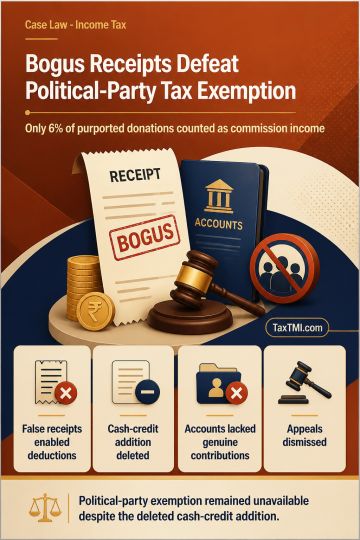
Bogus donation receipts justified commission income assessment and defeated political-party tax exemption for inaccurate accounts and reporting failur...
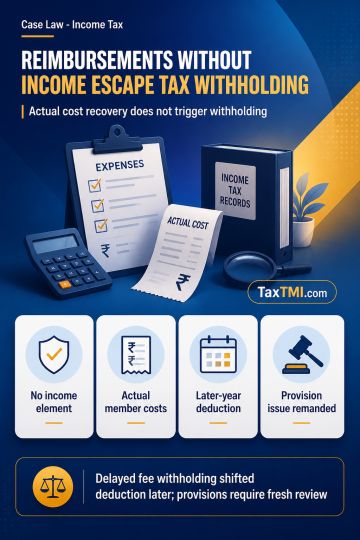
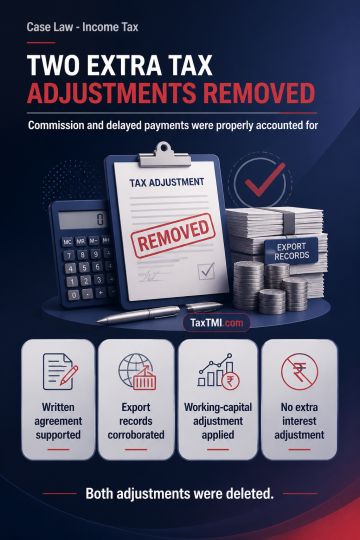
Pure reimbursement without income element escapes tax withholding, while delayed withholding and unsupported provisions face deferred or renewed scrut...
Public benefit requirement defeats charitable registration where residents' association services are reciprocal, member-only facilities governed by mu...
Exempt-income expenditure disallowance is confined to investments that actually generated exempt income, while supported business expenses remain dedu...
Objective characteristics and principal use govern mining-tyre classification, while fresh advance ruling applications may rely on additional technica...
Page of 4794
Press 'Enter' after typing page number.
581 to 600 of 95872 Results
❮
❯
❯❯
0 / 200
Expand Note
Add to Folder
No Folders have been created
+
Are you sure you want to delete "My most important" ?
The dispute pertained to the excise duty payable on certain goods, with the petitioner and the excise department adopting different classifications. The key issues were whether the disputes were arbitrable, whether the claims arose from a "change" in taxes under the NIT clause or revision in purchase orders, and the petitioner's entitlement to recover the price along with excise duty mentioned in invoices. The court held that the respondent had anticipated and notified the petitioner about the possibility of additional excise duty, and the evidence supported the conclusion that revenue authorities had recovered excise duty at 12.36% for the goods. The arbitrator's assessment of evidence and conclusions were reasonable. While the underlying legal argument was contested, the cited judgments elaborated on the analyzed argument but did not go to the root of the award. An award can only be interfered with if it contains errors going to the root of the matter, subject to disclosure of factual material and the parties' ability to challenge reliance on authorities within the statutory parameters. The court found no merit in the petition and dismissed it.
The dispute pertained to the excise duty payable on certain goods, with the petitioner and the excise department adopting different classifications. The key issues were whether the disputes were arbitrable, whether the claims arose from a "change" in taxes under the NIT clause or revision in purchase orders, and the petitioner's entitlement to recover the price along with excise duty mentioned in invoices. The court held that the respondent had anticipated and notified the petitioner about the possibility of additional excise duty, and the evidence supported the conclusion that revenue authorities had recovered excise duty at 12.36% for the goods. The arbitrator's assessment of evidence and conclusions were reasonable. While the underlying legal argument was contested, the cited judgments elaborated on the analyzed argument but did not go to the root of the award. An award can only be interfered with if it contains errors going to the root of the matter, subject to disclosure of factual material and the parties' ability to challenge reliance on authorities within the statutory parameters. The court found no merit in the petition and dismissed it.
Note: It is a system-generated summary and is for quick reference only.
 TaxTMI
 of 4794











 Join Channel


 TaxTMI