Business expenditure deduction requires proof of genuine commission payments and commercial allowability; turnover growth alone cannot validate the cl...
Article 8 treaty coverage excluded third-party airline support services, while documented demonetisation cash receipts remained accepted business inco...
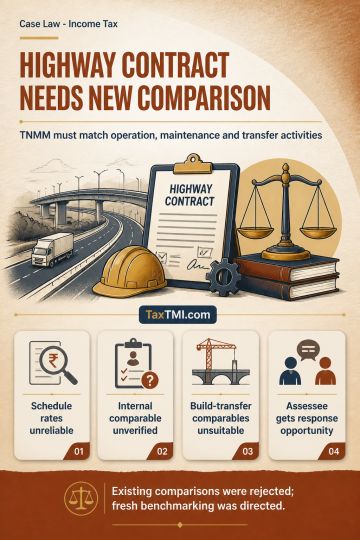
Functional comparability under TNMM requires highway contract benchmarks to reflect operation, maintenance and transfer activities, requiring fresh be...
Page of 4786
Press 'Enter' after typing page number.
241 to 260 of 95715 Results
❮
❯
❯❯
0 / 200
Expand Note
Add to Folder
No Folders have been created
+
Are you sure you want to delete "My most important" ?
Gross violation of CBEC instructions and the precedential value of CESTAT decisions. The Revenue filed an appeal before the first Appellate Authority without specifying grounds or reasons for departing from the Tribunal's order followed by the Adjudicating Authority. Section 35R(4) is applicable only to the Commissioner (Appeals) and Appellate Tribunal, requiring them to consider circumstances under which an earlier order was accepted and not challenged. This section does not set aside the principle of judicial precedents and the binding nature of higher Appellate Authority orders. Authorities below the Tribunal are bound by its earlier orders. The impugned order set aside the original authority's order solely because the Tribunal's order was accepted due to monetary limits, without stating grounds contrary to the Tribunal's observations. The original authority kept demand notices awaiting the Tribunal's decision and adjudicated accordingly after it set aside the order. The impugned order lacked merits for differing from the available higher Appellate Authority order without specifying grounds, leading to the appeal being allowed.
Gross violation of CBEC instructions and the precedential value of CESTAT decisions. The Revenue filed an appeal before the first Appellate Authority without specifying grounds or reasons for departing from the Tribunal's order followed by the Adjudicating Authority. Section 35R(4) is applicable only to the Commissioner (Appeals) and Appellate Tribunal, requiring them to consider circumstances under which an earlier order was accepted and not challenged. This section does not set aside the principle of judicial precedents and the binding nature of higher Appellate Authority orders. Authorities below the Tribunal are bound by its earlier orders. The impugned order set aside the original authority's order solely because the Tribunal's order was accepted due to monetary limits, without stating grounds contrary to the Tribunal's observations. The original authority kept demand notices awaiting the Tribunal's decision and adjudicated accordingly after it set aside the order. The impugned order lacked merits for differing from the available higher Appellate Authority order without specifying grounds, leading to the appeal being allowed.
Note: It is a system-generated summary and is for quick reference only.
 TaxTMI
 of 4786













 Join Channel


 TaxTMI