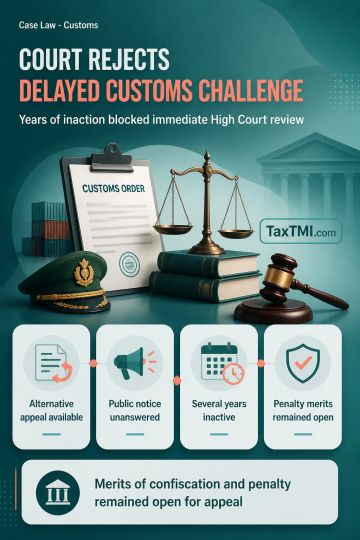
Alternative statutory remedy and unexplained delay barred writ review of customs confiscation adjudication, leaving merits for appellate consideration...
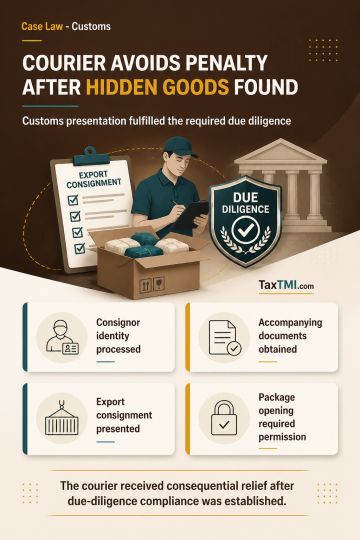
Authorised courier due diligence protects against penalties where declared exports conceal prohibited goods despite proper documentation and customs p...
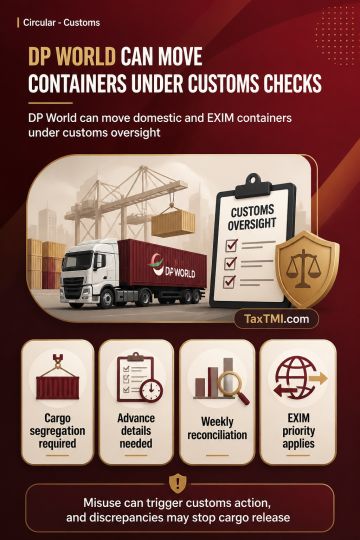
Customs-controlled container movement now extends to DP World facilities, subject to segregation, inspections, reconciliation, and EXIM cargo priority...
The appellant imported parts, components, and accessories at a concessional rate of customs duty under Notification No. 50/2017-Cus dated 30.06.2017, Entry No. 512, for manufacturing Lithium-ion batteries. However, it was alleged that the imported goods were used for manufacturing power banks instead. The term "manufacture" in the notification must be interpreted considering Rule 3(e) of the IGCR Rules, 2017. A cell is a single unit that converts chemical energy into electrical energy, while a battery is a group of cells. The term "manufacture" in Rule 3(e) is satisfied when a battery emerges as a distinct product from its components, i.e., individual lithium cells and others. The exemption under Entry No. 512 is available when the imported parts and components are used in the manufacture of lithium batteries, not necessarily as the final product. Since the appellant used the imported goods to manufacture Lithium-ion batteries, which were then captively used to manufacture power banks, the appellant is entitled to the exemption under Entry No. 512. The amendment made vide Notification Nos. 02/2019-Cus and 03/2019-Cus dated 29.01.2019 manifests that before the amendment, the subject goods were exempted under Notification No.
The appellant imported parts, components, and accessories at a concessional rate of customs duty under Notification No. 50/2017-Cus dated 30.06.2017, Entry No. 512, for manufacturing Lithium-ion batteries. However, it was alleged that the imported goods were used for manufacturing power banks instead. The term "manufacture" in the notification must be interpreted considering Rule 3(e) of the IGCR Rules, 2017. A cell is a single unit that converts chemical energy into electrical energy, while a battery is a group of cells. The term "manufacture" in Rule 3(e) is satisfied when a battery emerges as a distinct product from its components, i.e., individual lithium cells and others. The exemption under Entry No. 512 is available when the imported parts and components are used in the manufacture of lithium batteries, not necessarily as the final product. Since the appellant used the imported goods to manufacture Lithium-ion batteries, which were then captively used to manufacture power banks, the appellant is entitled to the exemption under Entry No. 512. The amendment made vide Notification Nos. 02/2019-Cus and 03/2019-Cus dated 29.01.2019 manifests that before the amendment, the subject goods were exempted under Notification No.
Note: It is a system-generated summary and is for quick reference only.
 TaxTMI
  TaxTMI
 of 4828









 Join Channel


