GST refunds for cancelled air tickets remain available when passenger reimbursements defeat unjust enrichment and credit-note adjustment is unavailabl...
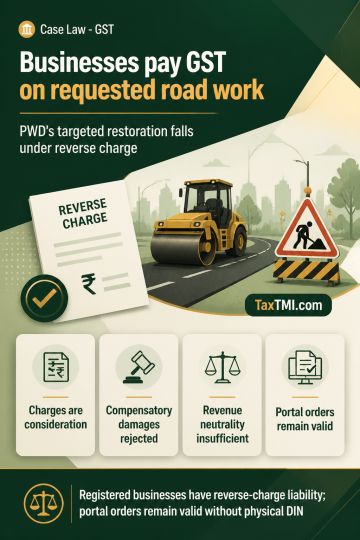
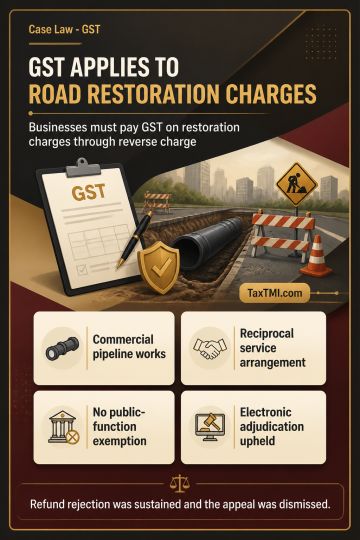
Request-driven road restoration attracts reverse-charge GST, not governmental-function treatment or compensatory-damages status for business recipient...
Road restoration charges for commercial pipeline works are taxable Government services, with reverse charge liability and no public-function exemption...
Determination of the limitation period for filing an appeal u/s 61 of the Insolvency and Bankruptcy Code, 2016, the scope of an "Aggrieved Person," and the principle of Estoppel by Conduct. The key points are: The appellant cannot claim the benefit of the extended limitation period due to COVID-19, as the mandatory 30-day period for applying for a certified copy of the impugned order had expired much before the extended period commenced on 15.03.2020. The appellant's failure to comply with the statutory requirement of procuring a certified copy within the prescribed time, despite having knowledge of the proceedings, creates a legal bar u/s 114 of the Evidence Act. The appellant's inaction to apply for a certified copy, despite having knowledge, would constitute an "Estoppel by Conduct." Consequently, the application for condonation of delay lacks merit and is dismissed.
Determination of the limitation period for filing an appeal u/s 61 of the Insolvency and Bankruptcy Code, 2016, the scope of an "Aggrieved Person," and the principle of Estoppel by Conduct. The key points are: The appellant cannot claim the benefit of the extended limitation period due to COVID-19, as the mandatory 30-day period for applying for a certified copy of the impugned order had expired much before the extended period commenced on 15.03.2020. The appellant's failure to comply with the statutory requirement of procuring a certified copy within the prescribed time, despite having knowledge of the proceedings, creates a legal bar u/s 114 of the Evidence Act. The appellant's inaction to apply for a certified copy, despite having knowledge, would constitute an "Estoppel by Conduct." Consequently, the application for condonation of delay lacks merit and is dismissed.
Note: It is a system-generated summary and is for quick reference only.
 TaxTMI
  TaxTMI
 of 4920