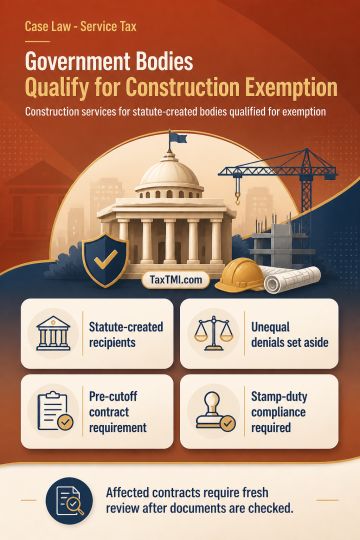
Governmental authority status supports construction-service exemption, while pre-cutoff contract and stamp-duty compliance requires verification on re...
Automated Free Sale and Commerce Certificates enable paperless processing while retaining risk-based manual verification for selected exporter applica...
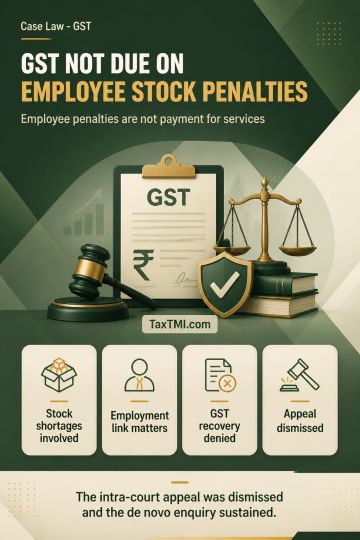
Employee stock-shortage penalties do not constitute consideration for services, preventing GST collection under Schedule II in employment relationship...
The ITAT held that the CIT(E) erred in prematurely invoking Section 13(1)(c) and cancelling the provisional registration u/s 12AB without duly considering the charitable objects of the assessee. Relying on judicial precedents, the ITAT clarified that the applicability of Section 13 should only be examined during assessment and not at the registration stage u/s 12A. The CIT(E)'s order was flawed in its interpretation of the assessee's objects and premature invocation of Section 13(1)(c) and 13(3). The ITAT set aside the CIT(E)'s order and restored the matter for de novo consideration, directing the CIT(E) to evaluate the application for registration afresh, focusing solely on the charitable nature of the assessee's objects, without invoking Section 13(1)(c) or Section 13(3) at this stage, and providing the assessee a reasonable opportunity of being heard.
The ITAT held that the CIT(E) erred in prematurely invoking Section 13(1)(c) and cancelling the provisional registration u/s 12AB without duly considering the charitable objects of the assessee. Relying on judicial precedents, the ITAT clarified that the applicability of Section 13 should only be examined during assessment and not at the registration stage u/s 12A. The CIT(E)'s order was flawed in its interpretation of the assessee's objects and premature invocation of Section 13(1)(c) and 13(3). The ITAT set aside the CIT(E)'s order and restored the matter for de novo consideration, directing the CIT(E) to evaluate the application for registration afresh, focusing solely on the charitable nature of the assessee's objects, without invoking Section 13(1)(c) or Section 13(3) at this stage, and providing the assessee a reasonable opportunity of being heard.
Note: It is a system-generated summary and is for quick reference only.
 TaxTMI
  TaxTMI
 of 4828






 Join Channel


