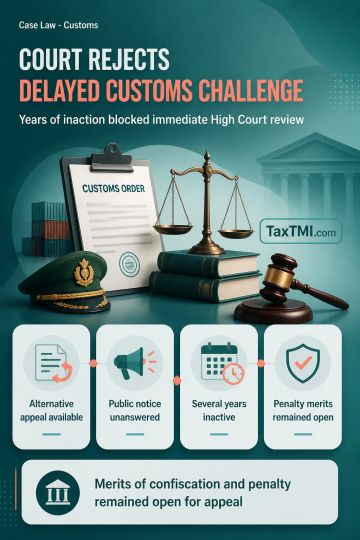
Alternative statutory remedy and unexplained delay barred writ review of customs confiscation adjudication, leaving merits for appellate consideration...
Authorised courier due diligence protects against penalties where declared exports conceal prohibited goods despite proper documentation and customs p...
Customs-controlled container movement now extends to DP World facilities, subject to segregation, inspections, reconciliation, and EXIM cargo priority...
The appellant was found guilty of bid rigging and cartelization in a tender process initiated by SBIIMS, contravening Sections 3(3)(c), 3(3)(d), and 3(1) of the Competition Act, 2002. The issue pertained to whether the penalty imposed on the appellant was proportionate to the offense, considering the criteria laid down in Excel Crop Care Ltd. vs CCI. The CCI differentiated the present case from Excel Crop Care, stating that the appellants were engaged in the supply of printed advertising/marketing materials, including signages, which constituted different varieties of the same product rather than multiple products. The CCI imposed a lenient penalty of 1% of the average relevant turnover for three financial years, despite the Act allowing up to 10%. The order was upheld by the Tribunal and the Supreme Court, attaining finality. The appeal was dismissed as lacking merit.
The appellant was found guilty of bid rigging and cartelization in a tender process initiated by SBIIMS, contravening Sections 3(3)(c), 3(3)(d), and 3(1) of the Competition Act, 2002. The issue pertained to whether the penalty imposed on the appellant was proportionate to the offense, considering the criteria laid down in Excel Crop Care Ltd. vs CCI. The CCI differentiated the present case from Excel Crop Care, stating that the appellants were engaged in the supply of printed advertising/marketing materials, including signages, which constituted different varieties of the same product rather than multiple products. The CCI imposed a lenient penalty of 1% of the average relevant turnover for three financial years, despite the Act allowing up to 10%. The order was upheld by the Tribunal and the Supreme Court, attaining finality. The appeal was dismissed as lacking merit.
Note: It is a system-generated summary and is for quick reference only.
 TaxTMI
  TaxTMI
 of 4828

















 Join Channel


