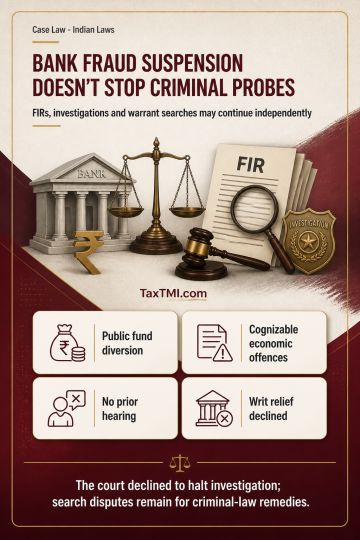
Administrative fraud classification suspension does not halt independent criminal investigation or warrant-based searches into alleged economic offenc...
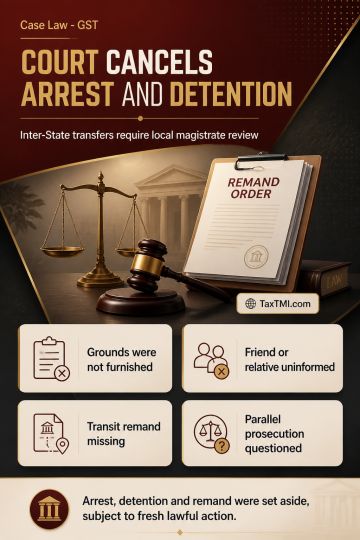
Arrest safeguards and transit remand requirements invalidated detention following inter-State transfer without communicated grounds or magistrate auth...
Arrest safeguards require disclosed grounds, relative intimation and transit remand, while duplicate prosecution under the CGST framework is unsustain...
Page of 4790
Press 'Enter' after typing page number.
521 to 540 of 95791 Results
❮
❯
❯❯
0 / 200
Expand Note
Add to Folder
No Folders have been created
+
Are you sure you want to delete "My most important" ?
The Negotiable Instruments Act, 1881 was enacted to define and amend laws relating to promissory notes, bills of exchange, and cheques. Section 138, introduced through the Banking, Public Financial Institutions and Negotiable Instruments Laws (Amendment) Act, 1988, provides penalties for dishonor of cheques due to insufficient funds. Subsequent amendments aimed to expedite cases through summary trials and make offenses compoundable. The Supreme Court highlighted the objective of instilling faith in banking operations and preventing dishonesty in drawing cheques without sufficient funds. The Bengal Money Lenders Act, 1940 and Chapter XVII of the Negotiable Instruments Act operate independently with distinct objectives. There is no conflict between provisions, and civil remedies for unlicensed money lenders are not barred by criminal penalties u/s 138. The High Court dismissed the revision application, finding no merit in claims of abuse of process.
The Negotiable Instruments Act, 1881 was enacted to define and amend laws relating to promissory notes, bills of exchange, and cheques. Section 138, introduced through the Banking, Public Financial Institutions and Negotiable Instruments Laws (Amendment) Act, 1988, provides penalties for dishonor of cheques due to insufficient funds. Subsequent amendments aimed to expedite cases through summary trials and make offenses compoundable. The Supreme Court highlighted the objective of instilling faith in banking operations and preventing dishonesty in drawing cheques without sufficient funds. The Bengal Money Lenders Act, 1940 and Chapter XVII of the Negotiable Instruments Act operate independently with distinct objectives. There is no conflict between provisions, and civil remedies for unlicensed money lenders are not barred by criminal penalties u/s 138. The High Court dismissed the revision application, finding no merit in claims of abuse of process.
Note: It is a system-generated summary and is for quick reference only.
 TaxTMI
 of 4790




 Join Channel


 TaxTMI

