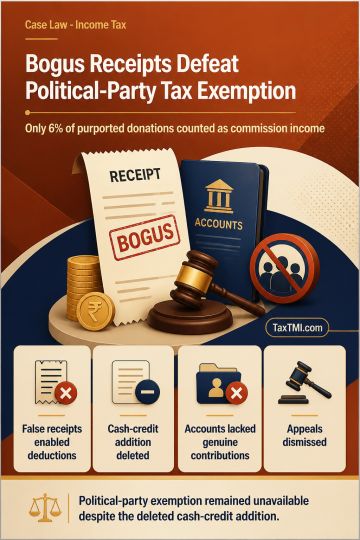
Bogus donation receipts justified commission income assessment and defeated political-party tax exemption for inaccurate accounts and reporting failur...
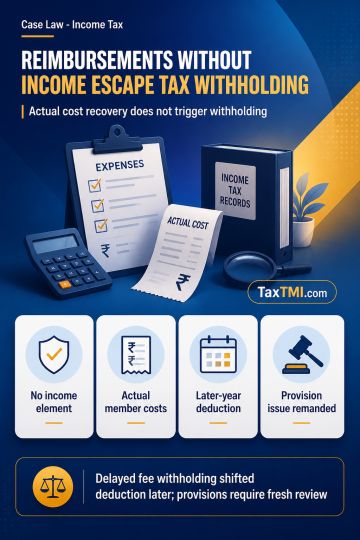
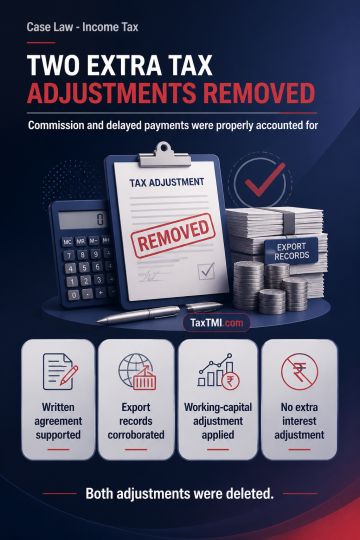
Pure reimbursement without income element escapes tax withholding, while delayed withholding and unsupported provisions face deferred or renewed scrut...
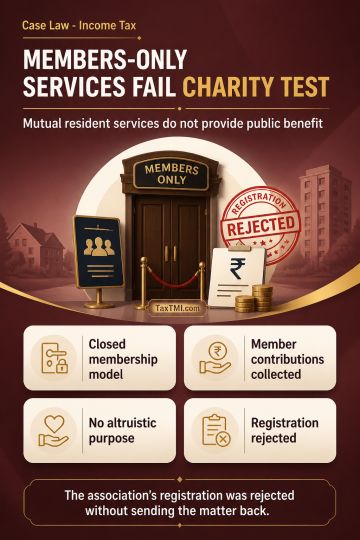
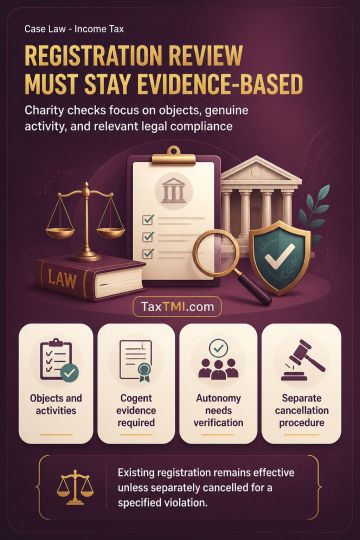
Public benefit requirement defeats charitable registration where residents' association services are reciprocal, member-only facilities governed by mu...
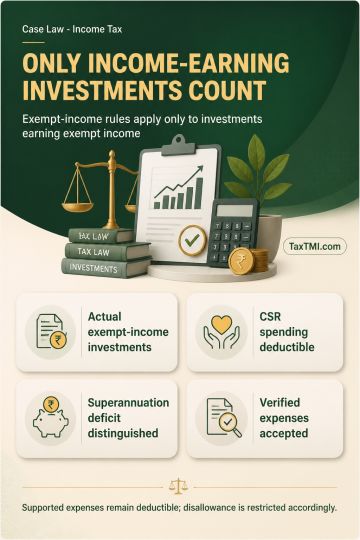
Exempt-income expenditure disallowance is confined to investments that actually generated exempt income, while supported business expenses remain dedu...
Objective characteristics and principal use govern mining-tyre classification, while fresh advance ruling applications may rely on additional technica...
Page of 4788
Press 'Enter' after typing page number.
461 to 480 of 95752 Results
❮
❯
❯❯
0 / 200
Expand Note
Add to Folder
No Folders have been created
+
Are you sure you want to delete "My most important" ?
The Negotiable Instruments Act, 1881 was enacted to define and amend laws relating to promissory notes, bills of exchange, and cheques. Section 138, introduced through the Banking, Public Financial Institutions and Negotiable Instruments Laws (Amendment) Act, 1988, provides penalties for dishonor of cheques due to insufficient funds. Subsequent amendments aimed to expedite cases through summary trials and make offenses compoundable. The Supreme Court highlighted the objective of instilling faith in banking operations and preventing dishonesty in drawing cheques without sufficient funds. The Bengal Money Lenders Act, 1940 and Chapter XVII of the Negotiable Instruments Act operate independently with distinct objectives. There is no conflict between provisions, and civil remedies for unlicensed money lenders are not barred by criminal penalties u/s 138. The High Court dismissed the revision application, finding no merit in claims of abuse of process.
The Negotiable Instruments Act, 1881 was enacted to define and amend laws relating to promissory notes, bills of exchange, and cheques. Section 138, introduced through the Banking, Public Financial Institutions and Negotiable Instruments Laws (Amendment) Act, 1988, provides penalties for dishonor of cheques due to insufficient funds. Subsequent amendments aimed to expedite cases through summary trials and make offenses compoundable. The Supreme Court highlighted the objective of instilling faith in banking operations and preventing dishonesty in drawing cheques without sufficient funds. The Bengal Money Lenders Act, 1940 and Chapter XVII of the Negotiable Instruments Act operate independently with distinct objectives. There is no conflict between provisions, and civil remedies for unlicensed money lenders are not barred by criminal penalties u/s 138. The High Court dismissed the revision application, finding no merit in claims of abuse of process.
Note: It is a system-generated summary and is for quick reference only.
 TaxTMI
 of 4788



 Join Channel


 TaxTMI