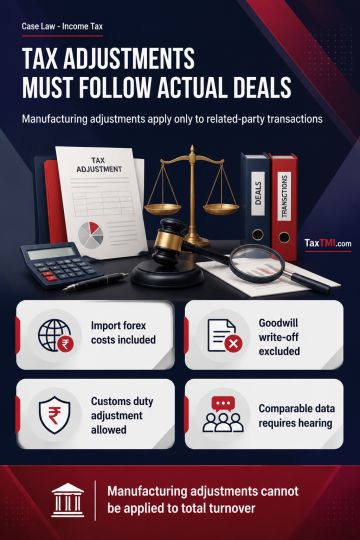
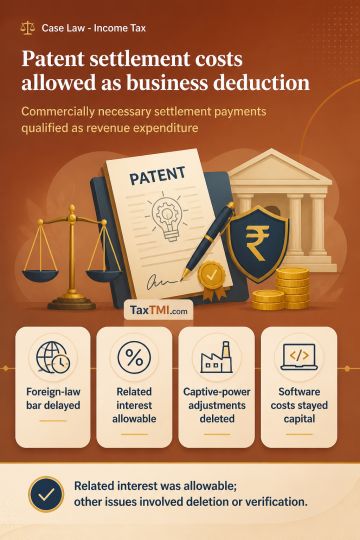
Patent-settlement expenditure treated as commercially expedient revenue outlay, with foreign-law restrictions inapplicable before the prospective amen...
International transaction benchmarking restricts transfer pricing adjustments to associated-enterprise dealings, while functional comparability govern...
Page of 4786
Press 'Enter' after typing page number.
161 to 180 of 95715 Results
❮
❯
❯❯
0 / 200
Expand Note
Add to Folder
No Folders have been created
+
Are you sure you want to delete "My most important" ?
GST is payable under reverse charge mechanism on issuance of corporate guarantee without consideration by foreign group company to Indian subsidiary for loan taken from banks/financial institutions. The time of supply is the date of entry in books of Indian recipient. Prior to 26.10.2023, GST is payable at the time of execution based on valuation u/r 28(1). Post 26.10.2023, GST is payable one-time at 1% of total loan value u/r 28(2) at the time of execution. For continuing guarantees spanning multiple years, the value needs to be divided equally among relevant years, with GST payable at 1% of such divided value for the first year and 1% of outstanding loan value for subsequent years u/r 28(2).
GST is payable under reverse charge mechanism on issuance of corporate guarantee without consideration by foreign group company to Indian subsidiary for loan taken from banks/financial institutions. The time of supply is the date of entry in books of Indian recipient. Prior to 26.10.2023, GST is payable at the time of execution based on valuation u/r 28(1). Post 26.10.2023, GST is payable one-time at 1% of total loan value u/r 28(2) at the time of execution. For continuing guarantees spanning multiple years, the value needs to be divided equally among relevant years, with GST payable at 1% of such divided value for the first year and 1% of outstanding loan value for subsequent years u/r 28(2).
Note: It is a system-generated summary and is for quick reference only.
 TaxTMI
 of 4786




 Join Channel


 TaxTMI