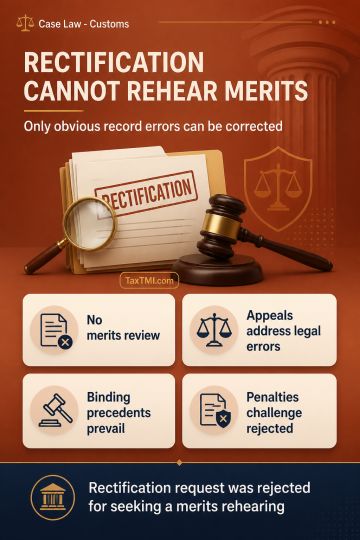
Rectification of mistake remains limited to self-evident record errors, preventing merits review through miscellaneous applications and preserving fin...
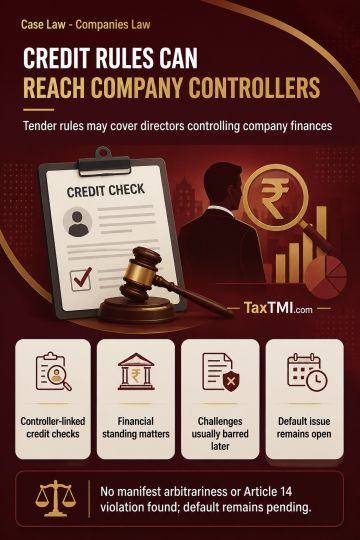
Tender creditworthiness conditions may extend to de facto Promoter Directors, with post-participation challenges generally barred absent arbitrariness...
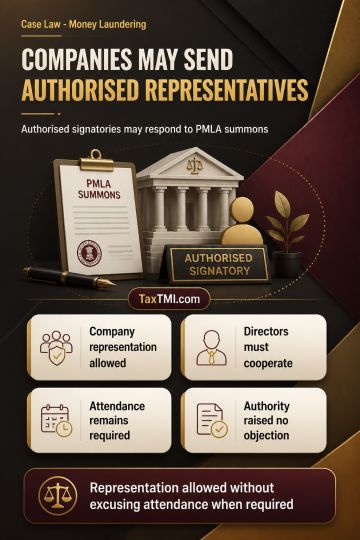
Corporate representation in PMLA summons proceedings permitted through an authorised signatory, subject to directors' continuing cooperation and atten...
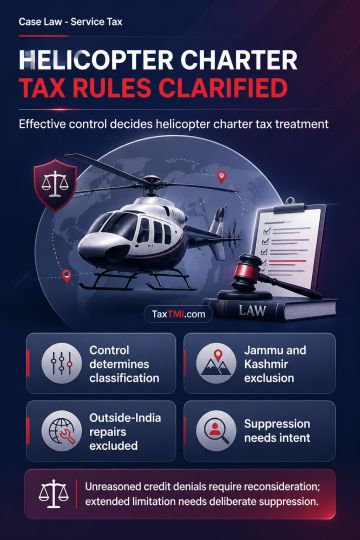
Helicopter charter classification requires effective control analysis, while territorial performance, reasoned credit orders and wilful suppression de...
Page of 4796
Press 'Enter' after typing page number.
781 to 800 of 95918 Results
❮
❯
❯❯
0 / 200
Expand Note
Add to Folder
No Folders have been created
+
Are you sure you want to delete "My most important" ?
The High Court held that once the Income Tax Appellate Tribunal (ITAT) found no cogent or convincing evidence from the Revenue to allege bogus purchases, it was wrong to expect the assessee to prove its innocence. The ITAT erred in upholding the Commissioner of Income Tax (Appeals) (CIT-A)'s ad hoc disallowance of 10% of the total purchases as bogus, without analyzing the reasonableness or justification for such disallowance. The ITAT's approach of adopting a middle ground by endorsing the 10% disallowance, despite finding no cogent evidence from the Revenue, gave credence to the proposition that the law can demand proof of the negative from the assessee. The High Court opined that such an approach is repugnant and cannot be endorsed as a process known to law to disallow expenses on the premise of being bogus. Consequently, the High Court ruled in favor of the assessee and against the Revenue.
The High Court held that once the Income Tax Appellate Tribunal (ITAT) found no cogent or convincing evidence from the Revenue to allege bogus purchases, it was wrong to expect the assessee to prove its innocence. The ITAT erred in upholding the Commissioner of Income Tax (Appeals) (CIT-A)'s ad hoc disallowance of 10% of the total purchases as bogus, without analyzing the reasonableness or justification for such disallowance. The ITAT's approach of adopting a middle ground by endorsing the 10% disallowance, despite finding no cogent evidence from the Revenue, gave credence to the proposition that the law can demand proof of the negative from the assessee. The High Court opined that such an approach is repugnant and cannot be endorsed as a process known to law to disallow expenses on the premise of being bogus. Consequently, the High Court ruled in favor of the assessee and against the Revenue.
Note: It is a system-generated summary and is for quick reference only.
 TaxTMI
 of 4796



 Join Channel


 TaxTMI