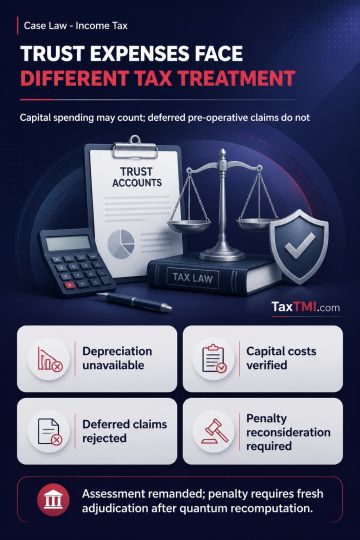
Charitable trust income application permits verified capital expenditure but rejects deferred pre-operative claims and requires reconsideration of con...
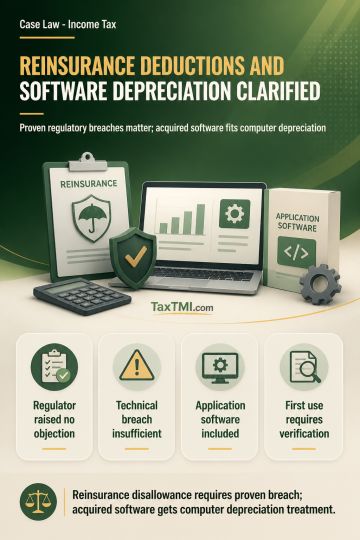
Reinsurance premium deductions require established regulatory breaches, while independently acquired software qualifies within the computer depreciati...
Rectification of mistake remains limited to self-evident record errors, preventing merits review through miscellaneous applications and preserving fin...
Tender creditworthiness conditions may extend to de facto Promoter Directors, with post-participation challenges generally barred absent arbitrariness...
Corporate representation in PMLA summons proceedings permitted through an authorised signatory, subject to directors' continuing cooperation and atten...
Page of 4801
Press 'Enter' after typing page number.
861 to 880 of 96001 Results
❮
❯
❯❯
0 / 200
Expand Note
Add to Folder
No Folders have been created
+
Are you sure you want to delete "My most important" ?
The NCLAT considered the applicability of time limitation for filing an appeal and whether there was sufficient cause for condonation of delay. It held that when an order is not pronounced in open court, the limitation period for filing an appeal does not commence, as per the Supreme Court's judgment in Sanjay Pandurang Kalate. Although the appellant claimed the order was not uploaded until 20.02.2024, the liquidator had communicated the order to the appellant on 25.01.2024. Therefore, the appellant could not claim that the limitation period would not begin at least from 25.01.2024. The expression "sufficient cause" is elastic, allowing courts to apply the law meaningfully to serve the ends of justice. The Supreme Court in Sheo Raj Singh vs. Union of India held that condonation of delay is a discretionary power, and its exercise depends on the sufficiency of the cause shown and the acceptability of the explanation, regardless of the length of delay. In the present case, no date of uploading was brought on record, so the limitation period could not be pegged to the date of uploading. However, since the appeal was filed on 02.03.2024, within 45 days from 25.01.2024 when the order was communicated, the NCLAT found sufficient cause to condone the delay.
The NCLAT considered the applicability of time limitation for filing an appeal and whether there was sufficient cause for condonation of delay. It held that when an order is not pronounced in open court, the limitation period for filing an appeal does not commence, as per the Supreme Court's judgment in Sanjay Pandurang Kalate. Although the appellant claimed the order was not uploaded until 20.02.2024, the liquidator had communicated the order to the appellant on 25.01.2024. Therefore, the appellant could not claim that the limitation period would not begin at least from 25.01.2024. The expression "sufficient cause" is elastic, allowing courts to apply the law meaningfully to serve the ends of justice. The Supreme Court in Sheo Raj Singh vs. Union of India held that condonation of delay is a discretionary power, and its exercise depends on the sufficiency of the cause shown and the acceptability of the explanation, regardless of the length of delay. In the present case, no date of uploading was brought on record, so the limitation period could not be pegged to the date of uploading. However, since the appeal was filed on 02.03.2024, within 45 days from 25.01.2024 when the order was communicated, the NCLAT found sufficient cause to condone the delay.
Note: It is a system-generated summary and is for quick reference only.
 TaxTMI
 of 4801














 Join Channel


 TaxTMI
