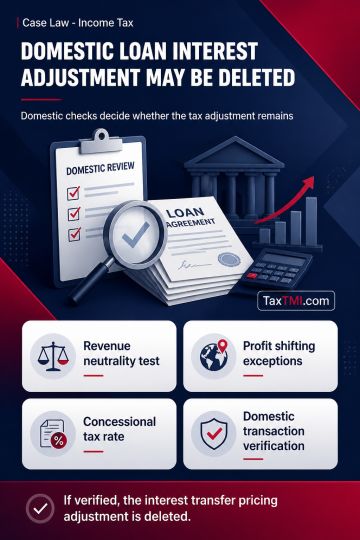
Revenue neutrality in domestic related-party loans can require deletion of interest transfer pricing adjustments after domestic-transaction verificati...
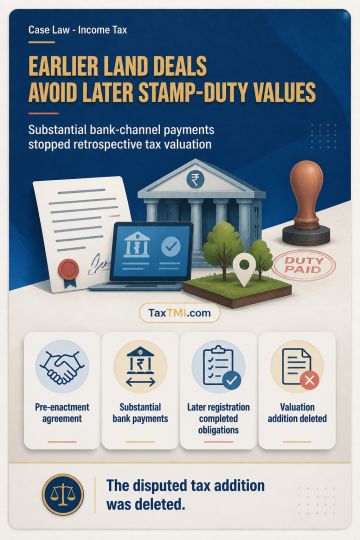
Pre-enactment land-sale agreements escape stamp-duty value substitution where substantial banking-channel consideration was received before Section 43...
Page of 4792
Press 'Enter' after typing page number.
121 to 140 of 95833 Results
❮
❯
❯❯
0 / 200
Expand Note
Add to Folder
No Folders have been created
+
Are you sure you want to delete "My most important" ?
The appellant, engaged in manufacturing soda ash, availed CENVAT credit amounting to Rs. 46,27,417/- for the period 03.12.2005 to 31.03.2012 on input services utilized at salt pans for procuring salt, a raw material for soda ash production. The department rejected the credit on the grounds that it was availed beyond one year from the date of invoice, relying on Sections 11A and 11B of the CENVAT Credit Rules, 2004. However, these sections do not prescribe any time limit for availing credit. The amendment introducing the one-year time limit was made on 11.07.2014, after the relevant period. Relying on the Roquette Riddhi Siddhi case, the Tribunal held that credit can be availed even after one year for invoices issued before 01.09.2014. Regarding the second issue, the Tribunal, relying on precedents like Parry Engineering, held that credit cannot be denied merely because the input service was utilized outside the factory premises, as long as it has a nexus with manufacturing activity. Since salt procurement from salt pans is directly related to soda ash manufacturing, the appellant is entitled to the CENVAT credit on such input services.
The appellant, engaged in manufacturing soda ash, availed CENVAT credit amounting to Rs. 46,27,417/- for the period 03.12.2005 to 31.03.2012 on input services utilized at salt pans for procuring salt, a raw material for soda ash production. The department rejected the credit on the grounds that it was availed beyond one year from the date of invoice, relying on Sections 11A and 11B of the CENVAT Credit Rules, 2004. However, these sections do not prescribe any time limit for availing credit. The amendment introducing the one-year time limit was made on 11.07.2014, after the relevant period. Relying on the Roquette Riddhi Siddhi case, the Tribunal held that credit can be availed even after one year for invoices issued before 01.09.2014. Regarding the second issue, the Tribunal, relying on precedents like Parry Engineering, held that credit cannot be denied merely because the input service was utilized outside the factory premises, as long as it has a nexus with manufacturing activity. Since salt procurement from salt pans is directly related to soda ash manufacturing, the appellant is entitled to the CENVAT credit on such input services.
Note: It is a system-generated summary and is for quick reference only.
 TaxTMI
 of 4792



 Join Channel


 TaxTMI