Prolonged sterilisation of development rights supports capital-gains treatment, while business-income disallowances cannot govern capital-gains comput...
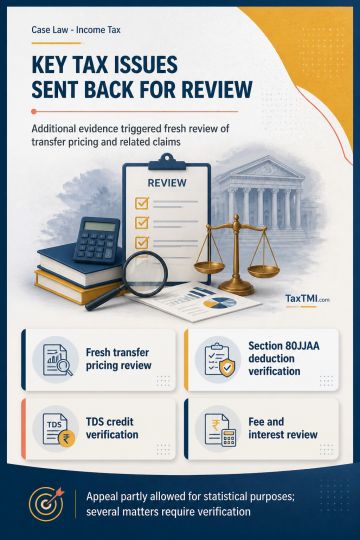
Additional evidence in transfer pricing dispute leads to fresh examination, while tax deductions, TDS credit, fee and refund interest require verifica...
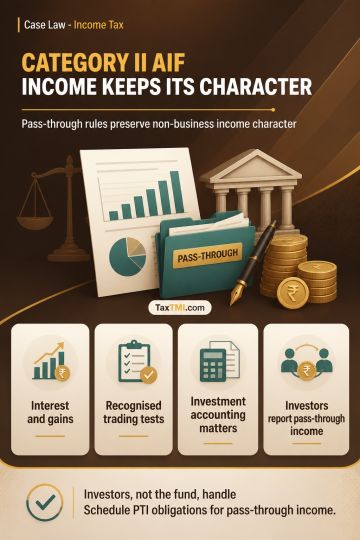
Category II AIF pass-through taxation preserves non-business income character; investment receipts cannot be reclassified without applying recognised ...
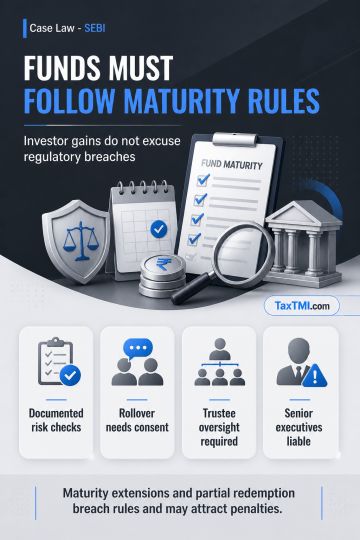
Mutual fund maturity rules require proper rollover, redemption, disclosure, and due diligence; investor gains cannot excuse regulatory breaches or pen...
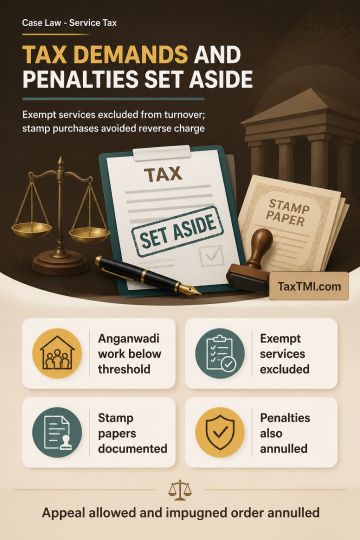
Threshold exemption excludes exempt services, while stamp-paper purchases avoid reverse charge; consequential service tax penalties were also set asid...
The appellant, engaged in manufacturing soda ash, availed CENVAT credit amounting to Rs. 46,27,417/- for the period 03.12.2005 to 31.03.2012 on input services utilized at salt pans for procuring salt, a raw material for soda ash production. The department rejected the credit on the grounds that it was availed beyond one year from the date of invoice, relying on Sections 11A and 11B of the CENVAT Credit Rules, 2004. However, these sections do not prescribe any time limit for availing credit. The amendment introducing the one-year time limit was made on 11.07.2014, after the relevant period. Relying on the Roquette Riddhi Siddhi case, the Tribunal held that credit can be availed even after one year for invoices issued before 01.09.2014. Regarding the second issue, the Tribunal, relying on precedents like Parry Engineering, held that credit cannot be denied merely because the input service was utilized outside the factory premises, as long as it has a nexus with manufacturing activity. Since salt procurement from salt pans is directly related to soda ash manufacturing, the appellant is entitled to the CENVAT credit on such input services.
The appellant, engaged in manufacturing soda ash, availed CENVAT credit amounting to Rs. 46,27,417/- for the period 03.12.2005 to 31.03.2012 on input services utilized at salt pans for procuring salt, a raw material for soda ash production. The department rejected the credit on the grounds that it was availed beyond one year from the date of invoice, relying on Sections 11A and 11B of the CENVAT Credit Rules, 2004. However, these sections do not prescribe any time limit for availing credit. The amendment introducing the one-year time limit was made on 11.07.2014, after the relevant period. Relying on the Roquette Riddhi Siddhi case, the Tribunal held that credit can be availed even after one year for invoices issued before 01.09.2014. Regarding the second issue, the Tribunal, relying on precedents like Parry Engineering, held that credit cannot be denied merely because the input service was utilized outside the factory premises, as long as it has a nexus with manufacturing activity. Since salt procurement from salt pans is directly related to soda ash manufacturing, the appellant is entitled to the CENVAT credit on such input services.
Note: It is a system-generated summary and is for quick reference only.
 TaxTMI
 of 4805







 Join Channel


 TaxTMI
