Transfer pricing and tax deductions upheld on established principles, while employee contributions and warranty provisions returned for fresh examinat...
Captive transfer pricing relies on industrial consumer tariffs, while genuine quotations can benchmark effluent treatment transfers under the Other Me...
Specific tariff classification for ophthalmic instruments and extended limitation principles determine the treatment of duty demands, confiscation, an...
Integrated golf function determines classification, placing launch monitors and simulators under other golf equipment rather than measuring instrument...
Public servant status under anti-corruption law extends to recognised stock exchange leadership; constitutional and sanction challenges do not succeed...
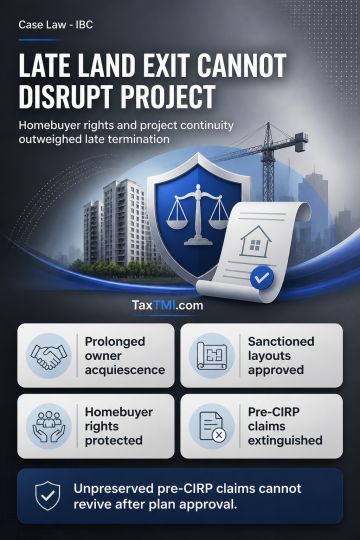
Acquiescence, homebuyer protection and clean-slate resolution principles prevent landowners from disrupting an integrated project through late termina...
The appellant, engaged in manufacturing soda ash, availed CENVAT credit amounting to Rs. 46,27,417/- for the period 03.12.2005 to 31.03.2012 on input services utilized at salt pans for procuring salt, a raw material for soda ash production. The department rejected the credit on the grounds that it was availed beyond one year from the date of invoice, relying on Sections 11A and 11B of the CENVAT Credit Rules, 2004. However, these sections do not prescribe any time limit for availing credit. The amendment introducing the one-year time limit was made on 11.07.2014, after the relevant period. Relying on the Roquette Riddhi Siddhi case, the Tribunal held that credit can be availed even after one year for invoices issued before 01.09.2014. Regarding the second issue, the Tribunal, relying on precedents like Parry Engineering, held that credit cannot be denied merely because the input service was utilized outside the factory premises, as long as it has a nexus with manufacturing activity. Since salt procurement from salt pans is directly related to soda ash manufacturing, the appellant is entitled to the CENVAT credit on such input services.
The appellant, engaged in manufacturing soda ash, availed CENVAT credit amounting to Rs. 46,27,417/- for the period 03.12.2005 to 31.03.2012 on input services utilized at salt pans for procuring salt, a raw material for soda ash production. The department rejected the credit on the grounds that it was availed beyond one year from the date of invoice, relying on Sections 11A and 11B of the CENVAT Credit Rules, 2004. However, these sections do not prescribe any time limit for availing credit. The amendment introducing the one-year time limit was made on 11.07.2014, after the relevant period. Relying on the Roquette Riddhi Siddhi case, the Tribunal held that credit can be availed even after one year for invoices issued before 01.09.2014. Regarding the second issue, the Tribunal, relying on precedents like Parry Engineering, held that credit cannot be denied merely because the input service was utilized outside the factory premises, as long as it has a nexus with manufacturing activity. Since salt procurement from salt pans is directly related to soda ash manufacturing, the appellant is entitled to the CENVAT credit on such input services.
Note: It is a system-generated summary and is for quick reference only.
 TaxTMI
 of 4803












 Join Channel


 TaxTMI