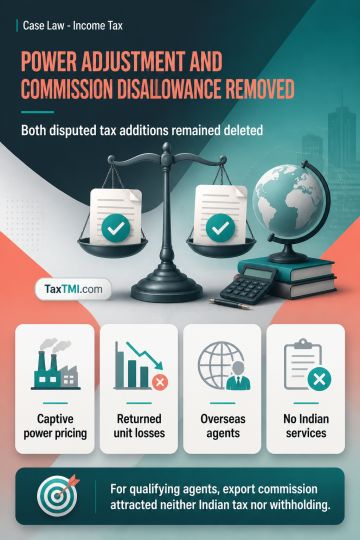
Captive power transfer pricing and non-resident export commission rules support deletion of adjustments and withholding disallowance in discussed proc...
Cooperative society deposits, member-interest TDS exemption and credit-facility deduction claims require verification through records and supporting e...
Customs jurisdiction over EPCG condition breaches survives export-obligation discharge certificates, requiring alleged fraud and misdeclaration to be ...
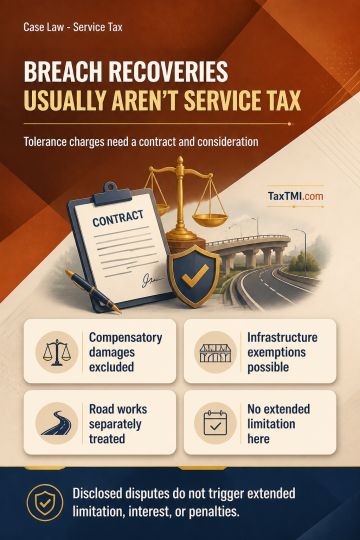
Contractual tolerance requires consideration; breach recoveries, qualifying public infrastructure services and road works escape service tax liability...
This is a case regarding levy of Central Excise Duty on Ready Mix Concrete (RMC) manufactured at construction sites by the appellant. The key points are: The appellant was manufacturing RMC at the site of the builder using raw materials provided by the builder, making it a job-work activity. The ownership of plant and machinery is irrelevant in determining job-work; the relationship between material supplier and processor is crucial. As the appellant was clearing goods manufactured on behalf of the builder, duty was payable by the appellant even as a job-worker. Regarding the extended period of limitation, it was held that due to a change in opinion based on a Supreme Court decision, the extended period could not be invoked, and the demand was confined to the normal period as correctly decided by the Commissioner (Appeals). The appellant's claim for concessional duty rate, if excess duty was due, was to be considered by the Original Adjudicating Authority. The appeal was dismissed, upholding the impugned order.
This is a case regarding levy of Central Excise Duty on Ready Mix Concrete (RMC) manufactured at construction sites by the appellant. The key points are: The appellant was manufacturing RMC at the site of the builder using raw materials provided by the builder, making it a job-work activity. The ownership of plant and machinery is irrelevant in determining job-work; the relationship between material supplier and processor is crucial. As the appellant was clearing goods manufactured on behalf of the builder, duty was payable by the appellant even as a job-worker. Regarding the extended period of limitation, it was held that due to a change in opinion based on a Supreme Court decision, the extended period could not be invoked, and the demand was confined to the normal period as correctly decided by the Commissioner (Appeals). The appellant's claim for concessional duty rate, if excess duty was due, was to be considered by the Original Adjudicating Authority. The appeal was dismissed, upholding the impugned order.
Note: It is a system-generated summary and is for quick reference only.
 TaxTMI
 of 4800













 Join Channel


 TaxTMI
