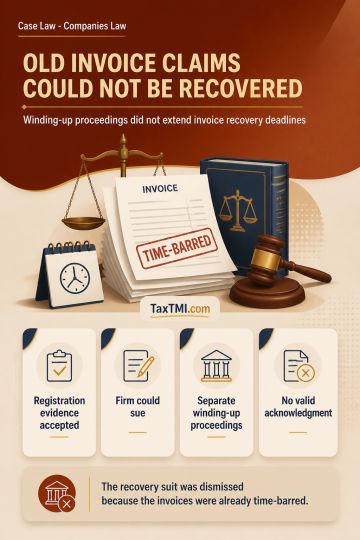
Invoice-based recovery claims remain time-barred despite separate winding-up proceedings, absent valid acknowledgment or part-payment of the disputed ...
Extended limitation fails without specific suppression allegations, while overseas employee secondment remains taxable as manpower supply within norma...
Time-share accommodation classification excludes Club or Association Service where purchasers receive contractual occupancy rights without genuine mem...
CENVAT credit for trading requires reversal, while taxable-service rental credit remains proportionately available and limitation issues await resolut...
Page of 4792
Press 'Enter' after typing page number.
61 to 80 of 95833 Results
❮
❯
❯❯
0 / 200
Expand Note
Add to Folder
No Folders have been created
+
Are you sure you want to delete "My most important" ?
This is a case regarding levy of Central Excise Duty on Ready Mix Concrete (RMC) manufactured at construction sites by the appellant. The key points are: The appellant was manufacturing RMC at the site of the builder using raw materials provided by the builder, making it a job-work activity. The ownership of plant and machinery is irrelevant in determining job-work; the relationship between material supplier and processor is crucial. As the appellant was clearing goods manufactured on behalf of the builder, duty was payable by the appellant even as a job-worker. Regarding the extended period of limitation, it was held that due to a change in opinion based on a Supreme Court decision, the extended period could not be invoked, and the demand was confined to the normal period as correctly decided by the Commissioner (Appeals). The appellant's claim for concessional duty rate, if excess duty was due, was to be considered by the Original Adjudicating Authority. The appeal was dismissed, upholding the impugned order.
This is a case regarding levy of Central Excise Duty on Ready Mix Concrete (RMC) manufactured at construction sites by the appellant. The key points are: The appellant was manufacturing RMC at the site of the builder using raw materials provided by the builder, making it a job-work activity. The ownership of plant and machinery is irrelevant in determining job-work; the relationship between material supplier and processor is crucial. As the appellant was clearing goods manufactured on behalf of the builder, duty was payable by the appellant even as a job-worker. Regarding the extended period of limitation, it was held that due to a change in opinion based on a Supreme Court decision, the extended period could not be invoked, and the demand was confined to the normal period as correctly decided by the Commissioner (Appeals). The appellant's claim for concessional duty rate, if excess duty was due, was to be considered by the Original Adjudicating Authority. The appeal was dismissed, upholding the impugned order.
Note: It is a system-generated summary and is for quick reference only.
 TaxTMI
 of 4792

















 Join Channel


 TaxTMI

