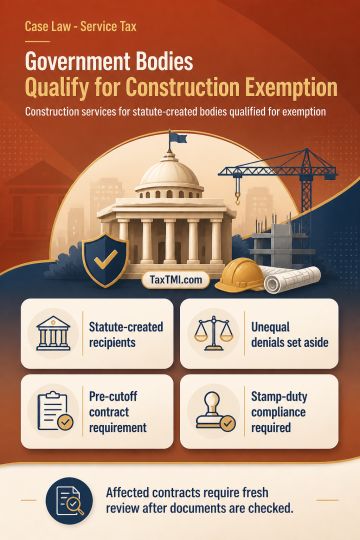
Governmental authority status supports construction-service exemption, while pre-cutoff contract and stamp-duty compliance requires verification on re...
Automated Free Sale and Commerce Certificates enable paperless processing while retaining risk-based manual verification for selected exporter applica...
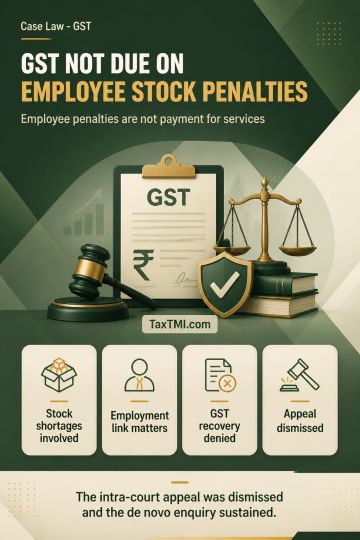
Employee stock-shortage penalties do not constitute consideration for services, preventing GST collection under Schedule II in employment relationship...
The assessment u/s 143(1) was invalid as the procedure laid down u/s 144B was not followed. The case was selected for regular assessment, but the assessee was not given an opportunity before making the addition. The revenue argued that the intimation order does not merge with the regular assessment when the Assessing Officer taxes the taxable income based on the intimation order u/s 143(1). However, it is well-settled law that an assessee cannot be taxed on an amount not legally imposable. The intimation u/s 143(1) was passed after selecting the case for regular assessment without giving the assessee an opportunity. The regular assessment u/s 143(3) was also passed within three months of the intimation order u/s 143(1). As per the Second Proviso to Section 143(1), no intimation can be sent after the expiry of the prescribed time limit. The assessee could have filed a rectification application u/s 154, which should have been disposed of within six months. However, the regular assessment was passed before that. The addition was proposed based on an apparent mistake, which the authorities failed to appreciate. The assessee did not claim the contingent liability in the profit and loss account, and the mistake was made by the tax auditor. The assessee cannot be penalized for the tax auditor's mistake. To achieve speedy justice, the Assessing.
The assessment u/s 143(1) was invalid as the procedure laid down u/s 144B was not followed. The case was selected for regular assessment, but the assessee was not given an opportunity before making the addition. The revenue argued that the intimation order does not merge with the regular assessment when the Assessing Officer taxes the taxable income based on the intimation order u/s 143(1). However, it is well-settled law that an assessee cannot be taxed on an amount not legally imposable. The intimation u/s 143(1) was passed after selecting the case for regular assessment without giving the assessee an opportunity. The regular assessment u/s 143(3) was also passed within three months of the intimation order u/s 143(1). As per the Second Proviso to Section 143(1), no intimation can be sent after the expiry of the prescribed time limit. The assessee could have filed a rectification application u/s 154, which should have been disposed of within six months. However, the regular assessment was passed before that. The addition was proposed based on an apparent mistake, which the authorities failed to appreciate. The assessee did not claim the contingent liability in the profit and loss account, and the mistake was made by the tax auditor. The assessee cannot be penalized for the tax auditor's mistake. To achieve speedy justice, the Assessing.
Note: It is a system-generated summary and is for quick reference only.
 TaxTMI
  TaxTMI
 of 4828





 Join Channel


