Specialized Investment Fund distribution now requires dedicated certification, while transitional recognition preserves existing qualified distributor...
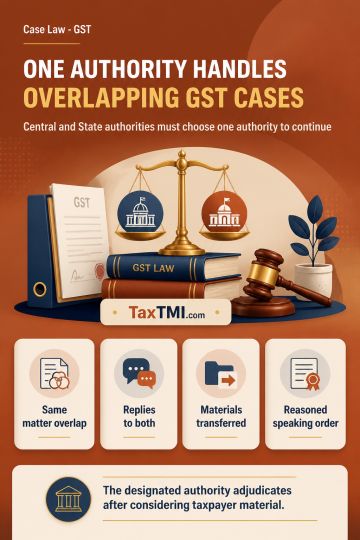
Overlapping GST proceedings require Central and State authorities to designate one competent authority for coordinated adjudication of the same matter...
Composite healthcare supplies retain exemption when patient care is the contract's essential character, despite payment through an implementing agency...
This circular clarifies the scope of regularization on an "as is" or "as is, where is" basis mentioned in previous GST circulars issued based on GST Council recommendations. It states that when genuine doubts arise due to competing entries with different rates or diverse interpretations, leading to some suppliers paying lower GST rates (including nil rates) and others paying higher rates, the Council recommends regularizing past payments on an "as is" basis. This means accepting the lower rate paid, without refunds for those who paid higher rates. The intention is to fully discharge tax liability based on the tax position taken by the taxpayer in filed returns. If two competing rates existed and the lower rate was paid, that payment is treated as tax fully paid for the regularized period, without requiring differential payment. Illustrations clarify scenarios like competing 5% and 12% rates, exemption versus 5% rate, and non-payment versus lower rates paid. The circular aims to provide clarity on the scope of "as is" regularization based on the Council's recommendations.
This circular clarifies the scope of regularization on an "as is" or "as is, where is" basis mentioned in previous GST circulars issued based on GST Council recommendations. It states that when genuine doubts arise due to competing entries with different rates or diverse interpretations, leading to some suppliers paying lower GST rates (including nil rates) and others paying higher rates, the Council recommends regularizing past payments on an "as is" basis. This means accepting the lower rate paid, without refunds for those who paid higher rates. The intention is to fully discharge tax liability based on the tax position taken by the taxpayer in filed returns. If two competing rates existed and the lower rate was paid, that payment is treated as tax fully paid for the regularized period, without requiring differential payment. Illustrations clarify scenarios like competing 5% and 12% rates, exemption versus 5% rate, and non-payment versus lower rates paid. The circular aims to provide clarity on the scope of "as is" regularization based on the Council's recommendations.
Note: It is a system-generated summary and is for quick reference only.
 TaxTMI
 of 4805











 Join Channel


 TaxTMI