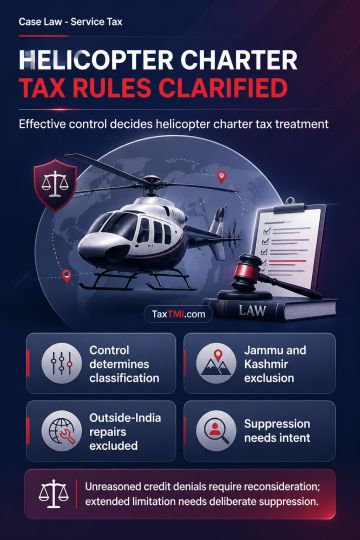
Helicopter charter classification requires effective control analysis, while territorial performance, reasoned credit orders and wilful suppression de...
Specified fund definition expands PAN exemption eligibility for registered alternative investment funds and qualifying International Financial Service...
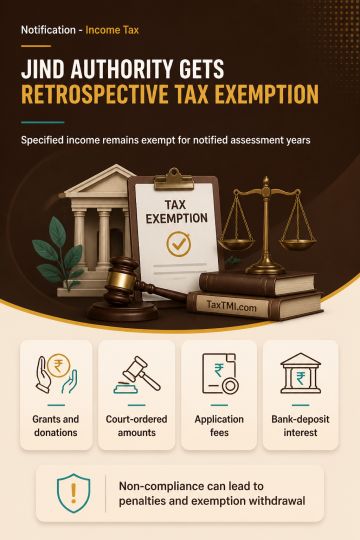
Tax exemption for specified legal-services authority income applies retrospectively, subject to non-commercial activity, unchanged income sources, and...
Approved resolution plans extinguish unsubmitted pre-approval tax claims, preventing later recovery outside the insolvency process and preserving a cl...
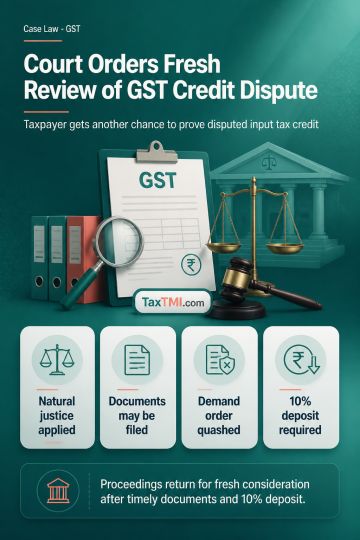
The court set aside the impugned order passed by the respondent u/s 73 of the Tamil Nadu General Sales Tax Act, 2017, imposing a liability of Rs. 10.72 lakhs towards tax, interest, and penalty on the petitioner due to a discrepancy between Forms GSTR 3B and GSTR 1. The petitioner claimed a violation of natural justice as they were unaware of the proceedings initiated by the respondent, with communication sent only through the portal. The court found sufficient materials to substantiate the petitioner's defense that there was no mismatch between the outward supplies turnover declared in GSTR-1 and GSTR-3B. Consistent with a previous case, the matter was remanded to the respondent for fresh consideration, subject to the petitioner paying 10% of the total demand within four weeks. The petition was allowed by way of remand.
The court set aside the impugned order passed by the respondent u/s 73 of the Tamil Nadu General Sales Tax Act, 2017, imposing a liability of Rs. 10.72 lakhs towards tax, interest, and penalty on the petitioner due to a discrepancy between Forms GSTR 3B and GSTR 1. The petitioner claimed a violation of natural justice as they were unaware of the proceedings initiated by the respondent, with communication sent only through the portal. The court found sufficient materials to substantiate the petitioner's defense that there was no mismatch between the outward supplies turnover declared in GSTR-1 and GSTR-3B. Consistent with a previous case, the matter was remanded to the respondent for fresh consideration, subject to the petitioner paying 10% of the total demand within four weeks. The petition was allowed by way of remand.
Note: It is a system-generated summary and is for quick reference only.
 TaxTMI
 of 4805














 Join Channel


 TaxTMI
