Authentication of paper assessment orders upheld, while qualifying repairs, consumables and vendor advance write-offs remain deductible business claim...
Transaction value cannot be rejected solely on non-statutory valuation guidelines without corroborative evidence supporting reassessment of final cust...
Cross-examination rights and corroborated evidence limit customs penalties for misdeclaration in genuine import transactions involving documented clea...
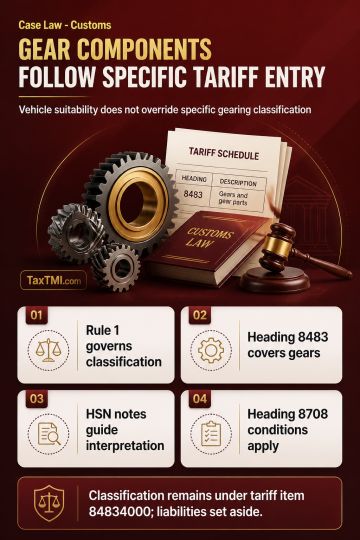
Tariff classification of vehicle gear components follows the specific gearing entry, displacing motor-vehicle parts classification and related liabili...
The court set aside the impugned order passed by the respondent u/s 73 of the Tamil Nadu General Sales Tax Act, 2017, imposing a liability of Rs. 10.72 lakhs towards tax, interest, and penalty on the petitioner due to a discrepancy between Forms GSTR 3B and GSTR 1. The petitioner claimed a violation of natural justice as they were unaware of the proceedings initiated by the respondent, with communication sent only through the portal. The court found sufficient materials to substantiate the petitioner's defense that there was no mismatch between the outward supplies turnover declared in GSTR-1 and GSTR-3B. Consistent with a previous case, the matter was remanded to the respondent for fresh consideration, subject to the petitioner paying 10% of the total demand within four weeks. The petition was allowed by way of remand.
The court set aside the impugned order passed by the respondent u/s 73 of the Tamil Nadu General Sales Tax Act, 2017, imposing a liability of Rs. 10.72 lakhs towards tax, interest, and penalty on the petitioner due to a discrepancy between Forms GSTR 3B and GSTR 1. The petitioner claimed a violation of natural justice as they were unaware of the proceedings initiated by the respondent, with communication sent only through the portal. The court found sufficient materials to substantiate the petitioner's defense that there was no mismatch between the outward supplies turnover declared in GSTR-1 and GSTR-3B. Consistent with a previous case, the matter was remanded to the respondent for fresh consideration, subject to the petitioner paying 10% of the total demand within four weeks. The petition was allowed by way of remand.
Note: It is a system-generated summary and is for quick reference only.
 TaxTMI
 of 4805


















 Join Channel


 TaxTMI