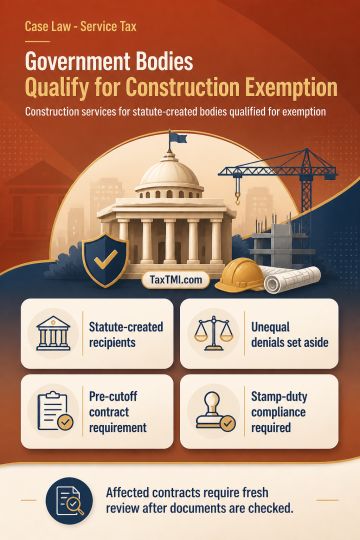
Governmental authority status supports construction-service exemption, while pre-cutoff contract and stamp-duty compliance requires verification on re...
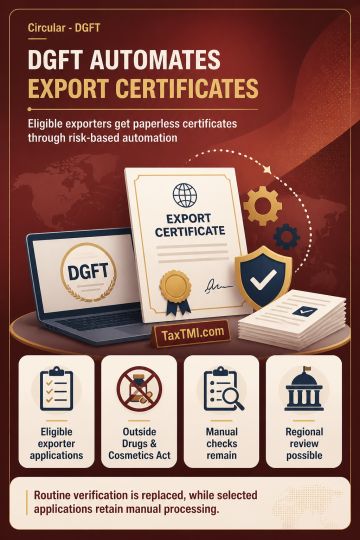
Automated Free Sale and Commerce Certificates enable paperless processing while retaining risk-based manual verification for selected exporter applica...
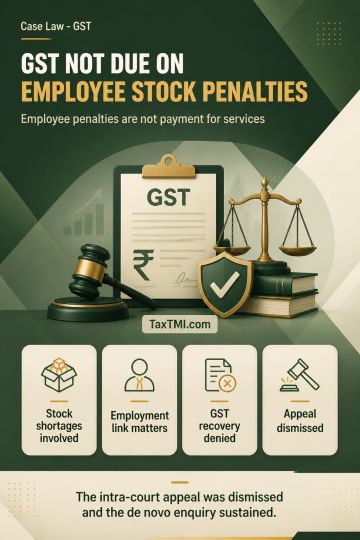
Employee stock-shortage penalties do not constitute consideration for services, preventing GST collection under Schedule II in employment relationship...
The assessee followed the correct method of valuing inventory by excluding recoverable VAT from the cost of purchases and inventory, in compliance with Accounting Standard 2 and the Income Computation and Disclosure Standards. The Assessing Officer erred by adding VAT to the closing stock without making corresponding adjustments to the opening stock and purchases. The Inclusive method was correctly applied by the assessee as per Section 145A, resulting in a nil impact on income. The ITAT relied on the Supreme Court's judgment in CIT v. Indo Nippon Chemicals Co. Ltd, which disallowed adopting different methods for purchases and closing stock valuation. Consequently, the addition made by the AO was incorrect and the assessee's appeal was allowed.
The assessee followed the correct method of valuing inventory by excluding recoverable VAT from the cost of purchases and inventory, in compliance with Accounting Standard 2 and the Income Computation and Disclosure Standards. The Assessing Officer erred by adding VAT to the closing stock without making corresponding adjustments to the opening stock and purchases. The Inclusive method was correctly applied by the assessee as per Section 145A, resulting in a nil impact on income. The ITAT relied on the Supreme Court's judgment in CIT v. Indo Nippon Chemicals Co. Ltd, which disallowed adopting different methods for purchases and closing stock valuation. Consequently, the addition made by the AO was incorrect and the assessee's appeal was allowed.
Note: It is a system-generated summary and is for quick reference only.
 TaxTMI
  TaxTMI
 of 4828






 Join Channel


