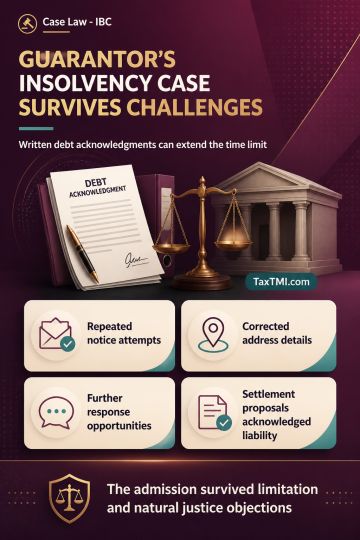
Service of notice and contractual debt acknowledgment preserved insolvency admission against a corporate guarantor despite limitation and natural just...
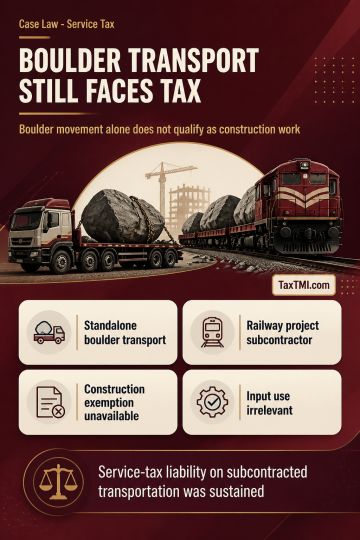
Original works exemption excludes standalone boulder transportation, leaving subcontracted railway-project transport services subject to service tax l...
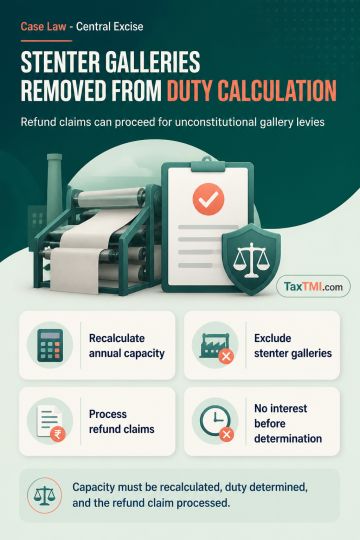
Annual production capacity determinations excluding stenter galleries support refunds for unconstitutional excise levies without an unjust-enrichment ...
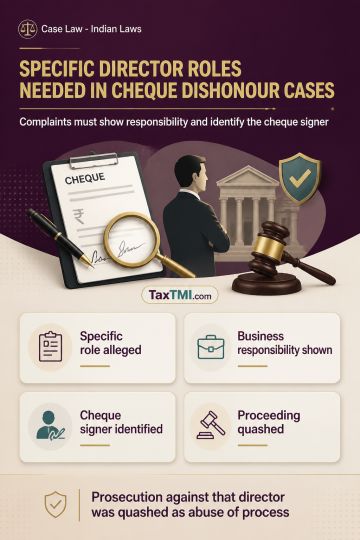
Vicarious liability for cheque dishonour requires specific allegations of responsibility and cheque signatory; generic director allegations cannot sus...
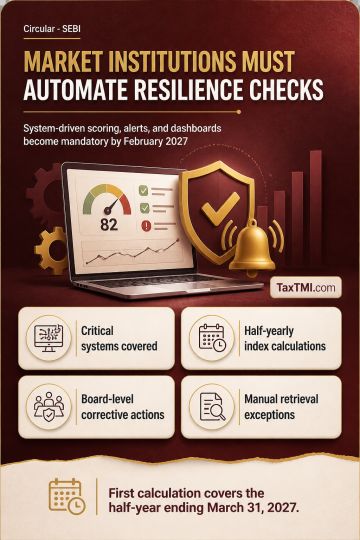
IT Resilience Index requires market infrastructure institutions to automate resilience scoring, early warnings, and continuous service-delivery monito...
Legal status of the assessee as a State or an agent of the State, based on Article 289 of the Constitution of India. It analyzes whether the assessee's activities are akin to those of the State, making it eligible for non-taxability. The assessee claimed deduction u/s 57 against interest income earned on fixed deposits with banks, offered under the head "income from other sources." The Tribunal applied the tests laid down by the Supreme Court in the Som Prakash Rekhi case to determine if the assessee falls within the term "State" under Article 12 of the Constitution. Agreeing that the assessee is an instrumentality/agent of the State, the Tribunal held that its interest income on fixed deposits is not chargeable to tax. Article 289(2) provides an exception for income derived from trade or business, but since the interest income was assessed under "income from other sources," this exception was deemed inapplicable. Consequently, the assessee's appeal was allowed.
Legal status of the assessee as a State or an agent of the State, based on Article 289 of the Constitution of India. It analyzes whether the assessee's activities are akin to those of the State, making it eligible for non-taxability. The assessee claimed deduction u/s 57 against interest income earned on fixed deposits with banks, offered under the head "income from other sources." The Tribunal applied the tests laid down by the Supreme Court in the Som Prakash Rekhi case to determine if the assessee falls within the term "State" under Article 12 of the Constitution. Agreeing that the assessee is an instrumentality/agent of the State, the Tribunal held that its interest income on fixed deposits is not chargeable to tax. Article 289(2) provides an exception for income derived from trade or business, but since the interest income was assessed under "income from other sources," this exception was deemed inapplicable. Consequently, the assessee's appeal was allowed.
Note: It is a system-generated summary and is for quick reference only.
 TaxTMI
  TaxTMI
 of 4828




 Join Channel