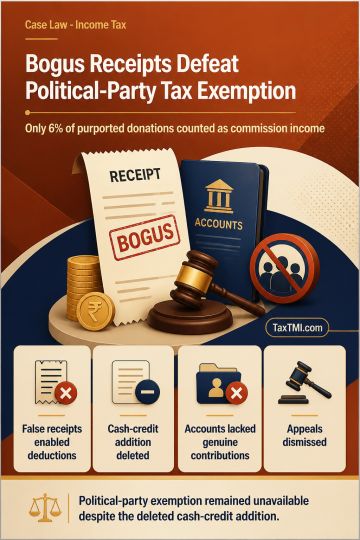
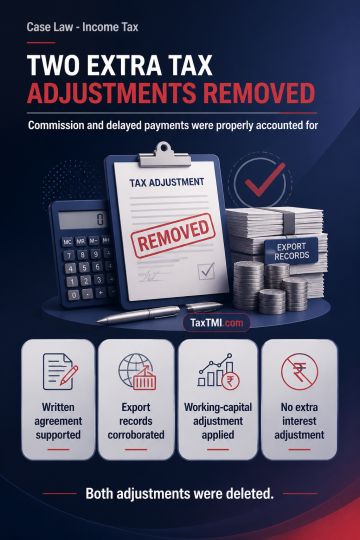
Bogus donation receipts justified commission income assessment and defeated political-party tax exemption for inaccurate accounts and reporting failur...
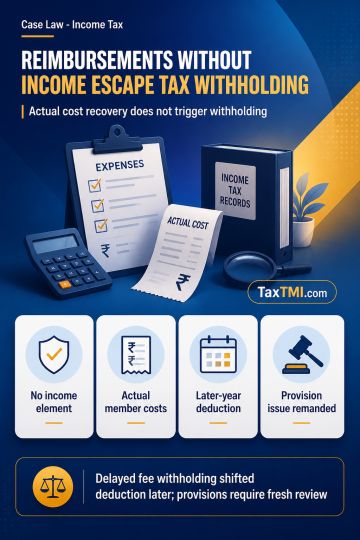
Pure reimbursement without income element escapes tax withholding, while delayed withholding and unsupported provisions face deferred or renewed scrut...
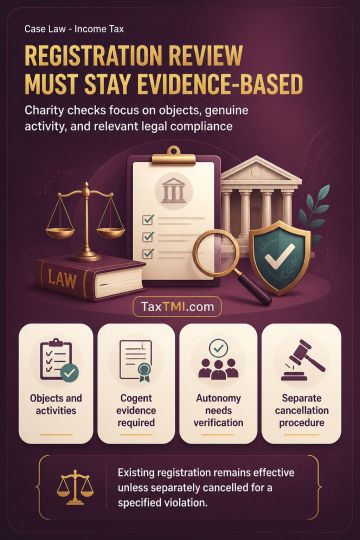
Public benefit requirement defeats charitable registration where residents' association services are reciprocal, member-only facilities governed by mu...
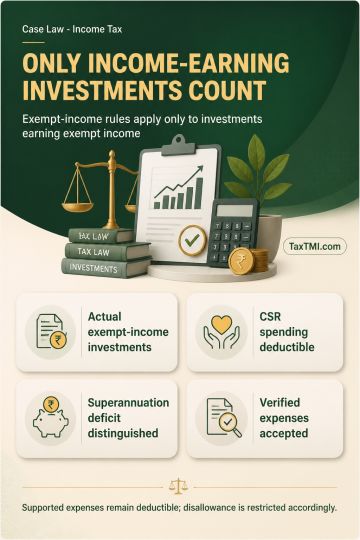
Exempt-income expenditure disallowance is confined to investments that actually generated exempt income, while supported business expenses remain dedu...
Objective characteristics and principal use govern mining-tyre classification, while fresh advance ruling applications may rely on additional technica...
Page of 4805
Press 'Enter' after typing page number.
801 to 820 of 96092 Results
❮
❯
❯❯
0 / 200
Expand Note
Add to Folder
No Folders have been created
+
Are you sure you want to delete "My most important" ?
The High Court held that the revenue authorities committed grave illegality by not granting pre-decisional hearing to the appellants before blocking their Electronic Credit Ledger u/r 86A of CGST Rules, violating principles of natural justice. The Court observed that although Rule 86A doesn't expressly provide for pre-decisional hearing, it has to be read into the provision when serious civil consequences arise. The authorities passed orders solely based on communication from another officer without independently analyzing if Input Tax Credit was on account of fake invoices, which is impermissible. The orders lacked valid material constituting 'reasons to believe' and were passed on borrowed satisfaction, rendering them bald, vague, and unreasoned. Quashing the impugned orders, the Court allowed the appeals, holding that the mandatory requirements for invoking Rule 86A were not fulfilled by the revenue authorities.
The High Court held that the revenue authorities committed grave illegality by not granting pre-decisional hearing to the appellants before blocking their Electronic Credit Ledger u/r 86A of CGST Rules, violating principles of natural justice. The Court observed that although Rule 86A doesn't expressly provide for pre-decisional hearing, it has to be read into the provision when serious civil consequences arise. The authorities passed orders solely based on communication from another officer without independently analyzing if Input Tax Credit was on account of fake invoices, which is impermissible. The orders lacked valid material constituting 'reasons to believe' and were passed on borrowed satisfaction, rendering them bald, vague, and unreasoned. Quashing the impugned orders, the Court allowed the appeals, holding that the mandatory requirements for invoking Rule 86A were not fulfilled by the revenue authorities.
Note: It is a system-generated summary and is for quick reference only.
 TaxTMI
 of 4805




 Join Channel


 TaxTMI