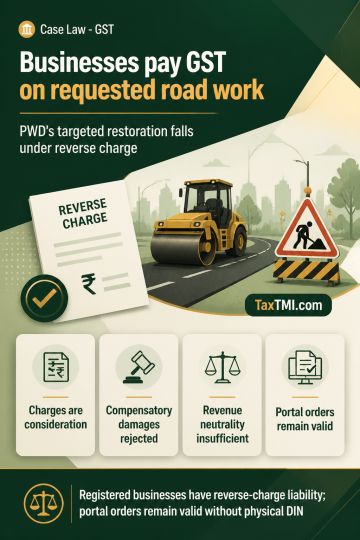
Request-driven road restoration attracts reverse-charge GST, not governmental-function treatment or compensatory-damages status for business recipient...
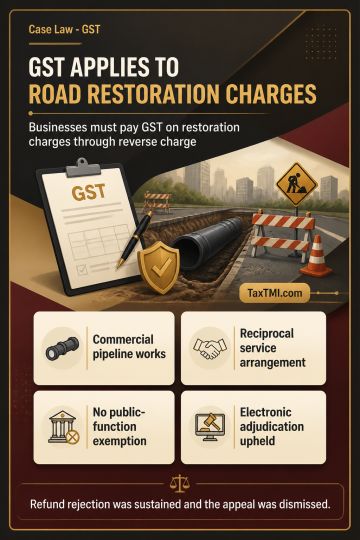
Road restoration charges for commercial pipeline works are taxable Government services, with reverse charge liability and no public-function exemption...
Model-wise import cap monitoring cannot justify withholding used multifunction machines where all-India tracking is absent and full security is furnis...
The High Court quashed the order invoking Rule 86A for blocking the Electronic Credit Ledger (ECL) of the petitioner under the CGST/SGST Rules, 2017. The impugned order lacked independent or cogent reasons and relied on reports of enforcement authorities, which is impermissible. Crucially, no pre-decisional hearing was granted, violating principles of natural justice. The order erroneously described the supplier as non-existent or not conducting business, despite the supplier obtaining registration and the transaction occurring before cancellation of registration. The court held that the order failed to provide valid reasons for blocking the ECL, thereby warranting its quashing.
The High Court quashed the order invoking Rule 86A for blocking the Electronic Credit Ledger (ECL) of the petitioner under the CGST/SGST Rules, 2017. The impugned order lacked independent or cogent reasons and relied on reports of enforcement authorities, which is impermissible. Crucially, no pre-decisional hearing was granted, violating principles of natural justice. The order erroneously described the supplier as non-existent or not conducting business, despite the supplier obtaining registration and the transaction occurring before cancellation of registration. The court held that the order failed to provide valid reasons for blocking the ECL, thereby warranting its quashing.
Note: It is a system-generated summary and is for quick reference only.
 TaxTMI
  TaxTMI
 of 4918