Cooperative society deposits, member-interest TDS exemption and credit-facility deduction claims require verification through records and supporting e...
Customs jurisdiction over EPCG condition breaches survives export-obligation discharge certificates, requiring alleged fraud and misdeclaration to be ...
Contractual tolerance requires consideration; breach recoveries, qualifying public infrastructure services and road works escape service tax liability...
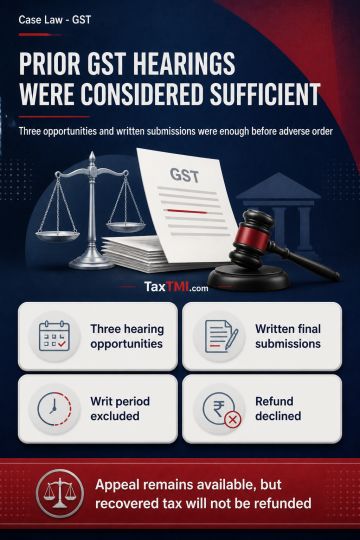
Personal hearing requirements in GST adjudication were satisfied by prior opportunities and written submissions; appellate limitation received writ-pe...
The High Court addressed the issue of refund of unutilized Input Tax Credit where remittances were received in a different branch's bank account. The Court held that establishments should be treated as distinct persons under the CGST Act, even if they are part of the same entity. The petitioner had initially not provided bank account details for its Delhi branch but later updated them, including a Bangalore bank account where remittances were credited. The Court observed that these remittances were clearly connected to services rendered by the Delhi branch, and the objection raised was overly technical and unsustainable. The Court clarified that the CGST Act contemplates entities having multiple establishments across states, and Section 25(4) and (5) override the principle of branch offices not being separate juridical entities. Consequently, the High Court quashed the impugned orders and allowed the petition.
The High Court addressed the issue of refund of unutilized Input Tax Credit where remittances were received in a different branch's bank account. The Court held that establishments should be treated as distinct persons under the CGST Act, even if they are part of the same entity. The petitioner had initially not provided bank account details for its Delhi branch but later updated them, including a Bangalore bank account where remittances were credited. The Court observed that these remittances were clearly connected to services rendered by the Delhi branch, and the objection raised was overly technical and unsustainable. The Court clarified that the CGST Act contemplates entities having multiple establishments across states, and Section 25(4) and (5) override the principle of branch offices not being separate juridical entities. Consequently, the High Court quashed the impugned orders and allowed the petition.
Note: It is a system-generated summary and is for quick reference only.
 TaxTMI
 of 4805











 Join Channel


 TaxTMI