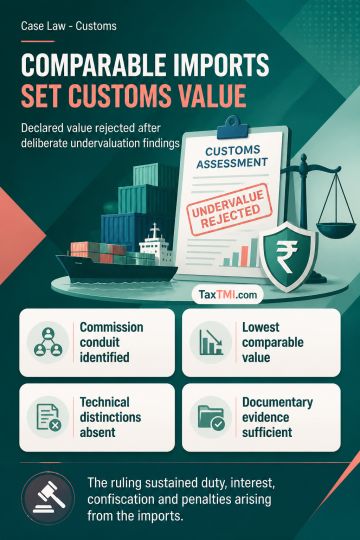
Transaction value rejection requires reliable corroboration; refundable VAT is excluded and temporary registration does not defeat new-vehicle exempti...
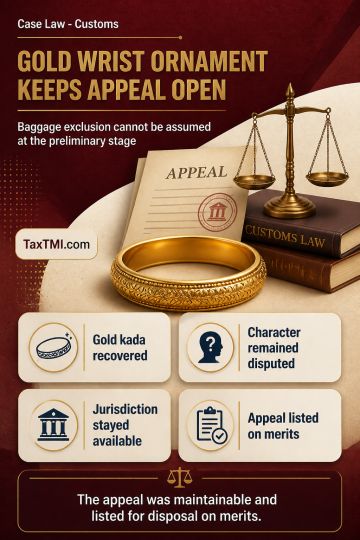
Appellate jurisdiction remains available where a wrist-worn gold ornament cannot conclusively be characterised as imported baggage at the preliminary ...
Written complaint requirement bars cognizance on police reports for securities offences, while unsupported breach of trust and cheating allegations fa...
Page of 4801
Press 'Enter' after typing page number.
341 to 360 of 96001 Results
❮
❯
❯❯
0 / 200
Expand Note
Add to Folder
No Folders have been created
+
Are you sure you want to delete "My most important" ?
The High Court addressed the issue of refund of unutilized Input Tax Credit where remittances were received in a different branch's bank account. The Court held that establishments should be treated as distinct persons under the CGST Act, even if they are part of the same entity. The petitioner had initially not provided bank account details for its Delhi branch but later updated them, including a Bangalore bank account where remittances were credited. The Court observed that these remittances were clearly connected to services rendered by the Delhi branch, and the objection raised was overly technical and unsustainable. The Court clarified that the CGST Act contemplates entities having multiple establishments across states, and Section 25(4) and (5) override the principle of branch offices not being separate juridical entities. Consequently, the High Court quashed the impugned orders and allowed the petition.
The High Court addressed the issue of refund of unutilized Input Tax Credit where remittances were received in a different branch's bank account. The Court held that establishments should be treated as distinct persons under the CGST Act, even if they are part of the same entity. The petitioner had initially not provided bank account details for its Delhi branch but later updated them, including a Bangalore bank account where remittances were credited. The Court observed that these remittances were clearly connected to services rendered by the Delhi branch, and the objection raised was overly technical and unsustainable. The Court clarified that the CGST Act contemplates entities having multiple establishments across states, and Section 25(4) and (5) override the principle of branch offices not being separate juridical entities. Consequently, the High Court quashed the impugned orders and allowed the petition.
Note: It is a system-generated summary and is for quick reference only.
 TaxTMI
 of 4801











 Join Channel


 TaxTMI