Exempt-income expenditure disallowance is confined to investments that actually generated exempt income, while supported business expenses remain dedu...
Objective characteristics and principal use govern mining-tyre classification, while fresh advance ruling applications may rely on additional technica...
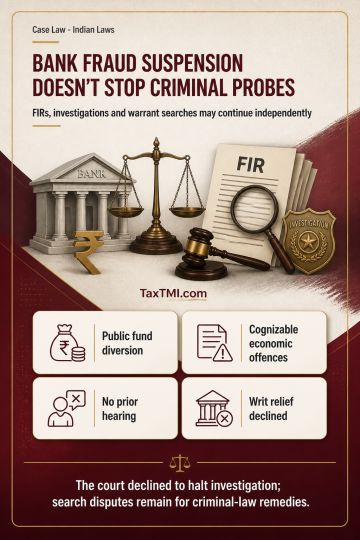
Administrative fraud classification suspension does not halt independent criminal investigation or warrant-based searches into alleged economic offenc...
The assessing officer made an addition u/s 41(1) on the grounds that the assessee had ceased trading liabilities, even though the assessee did not respond to notices/summons issued u/ss 133(6)/131. The assessee contended that no remission or cessation of liabilities had occurred and no benefit was received, hence the liability cannot be considered income. The ITAT, relying on the Rajasthan High Court's decision in CIT vs. Narendra Mohan Mathur, held that the onus is on the assessing officer to conclusively prove that the liabilities ceased to exist or the assessee obtained any amount/benefit concerning such liabilities. As the assessing officer failed to discharge this onus, the ITAT directed deletion of the addition made u/s 41(1).
The assessing officer made an addition u/s 41(1) on the grounds that the assessee had ceased trading liabilities, even though the assessee did not respond to notices/summons issued u/ss 133(6)/131. The assessee contended that no remission or cessation of liabilities had occurred and no benefit was received, hence the liability cannot be considered income. The ITAT, relying on the Rajasthan High Court's decision in CIT vs. Narendra Mohan Mathur, held that the onus is on the assessing officer to conclusively prove that the liabilities ceased to exist or the assessee obtained any amount/benefit concerning such liabilities. As the assessing officer failed to discharge this onus, the ITAT directed deletion of the addition made u/s 41(1).
Note: It is a system-generated summary and is for quick reference only.
 TaxTMI
  TaxTMI
 of 4807













 Join Channel