Defined public benefit can retain charitable character; registration renewal requires examining genuine activities and legal compliance, not surplus a...
Capital reduction is distinct from share buy-back, preventing buy-back tax; restructuring interest and related business deductions also survive scruti...
Transfer pricing and tax deductions upheld on established principles, while employee contributions and warranty provisions returned for fresh examinat...
Captive transfer pricing relies on industrial consumer tariffs, while genuine quotations can benchmark effluent treatment transfers under the Other Me...
Specific tariff classification for ophthalmic instruments and extended limitation principles determine the treatment of duty demands, confiscation, an...
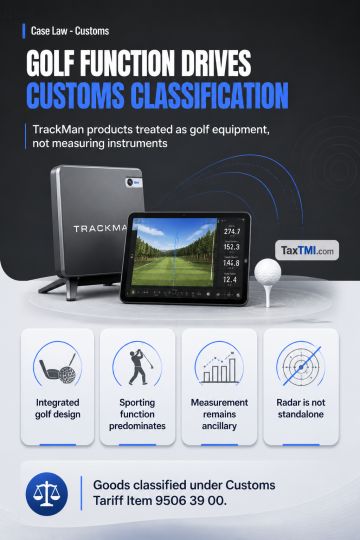
Integrated golf function determines classification, placing launch monitors and simulators under other golf equipment rather than measuring instrument...
The case revolves around the rejection of the declared value by customs authorities and the subsequent enhancement of value based on a quotation obtained from a different supplier. The key points are: The original authority rejected the declared value and determined the value based on a quotation from another supplier, which was accepted by the importer. However, the Tribunal held that a proforma invoice or quotation cannot constitute a valid basis for enhancing the value of imported goods, as per the precedent set in the Sahara Enterprises case. The transaction value accepted by another importer in a different case cannot be the basis for valuation in the present case, where there is no such consent from the importer. Transaction value is a function of price, but there was no evidence of any flow back or additional payment by the importer over the declared transaction value. The Revenue failed to prove its case, and the impugned order was set aside by the Appellate Tribunal.
The case revolves around the rejection of the declared value by customs authorities and the subsequent enhancement of value based on a quotation obtained from a different supplier. The key points are: The original authority rejected the declared value and determined the value based on a quotation from another supplier, which was accepted by the importer. However, the Tribunal held that a proforma invoice or quotation cannot constitute a valid basis for enhancing the value of imported goods, as per the precedent set in the Sahara Enterprises case. The transaction value accepted by another importer in a different case cannot be the basis for valuation in the present case, where there is no such consent from the importer. Transaction value is a function of price, but there was no evidence of any flow back or additional payment by the importer over the declared transaction value. The Revenue failed to prove its case, and the impugned order was set aside by the Appellate Tribunal.
Note: It is a system-generated summary and is for quick reference only.
 TaxTMI
  TaxTMI
 of 4809




















 Join Channel