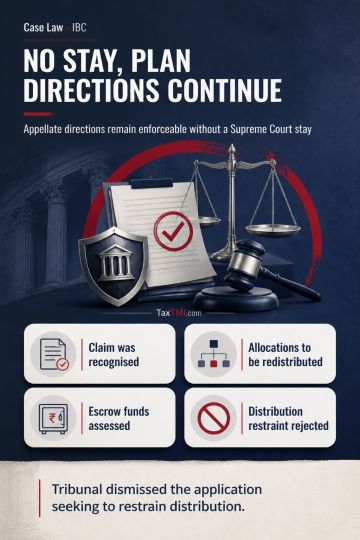
Enforcement of resolution-plan directions continues without a Supreme Court stay, preventing suspension of redistribution and escrowed-fund distributi...
Third-party ownership claims over attached property require Special Court adjudication where purchasers lack registered sale deeds and bona fides rema...
Pure-agent reimbursements in clearing and forwarding services are excluded from taxable value when qualifying third-party payments are properly record...
Customs relief for Strait of Hormuz maritime disruptions remains available, with existing conditions continuing unchanged through the extended validit...
The Appellate Tribunal found the Interim Resolution Professional's (IRP) conduct to be biased, premeditated, and authoritarian, violating the core objectives and principles of the Insolvency and Bankruptcy Code (IBC). The IRP prematurely admitted the claim of a creditor and reconstituted the Committee of Creditors (CoC) after being voted out, enabling the new creditor to appoint him as the Resolution Professional (RP). This collusive practice compromised the integrity and transparency of the insolvency resolution process. The Tribunal held that such conduct goes against the objectives of the IBC and could enable erstwhile promoters' re-entry into the corporate debtor. Consequently, the appeal was dismissed, emphasizing the need for neutrality and impartiality in CIRP proceedings to uphold the IBC's principles.
The Appellate Tribunal found the Interim Resolution Professional's (IRP) conduct to be biased, premeditated, and authoritarian, violating the core objectives and principles of the Insolvency and Bankruptcy Code (IBC). The IRP prematurely admitted the claim of a creditor and reconstituted the Committee of Creditors (CoC) after being voted out, enabling the new creditor to appoint him as the Resolution Professional (RP). This collusive practice compromised the integrity and transparency of the insolvency resolution process. The Tribunal held that such conduct goes against the objectives of the IBC and could enable erstwhile promoters' re-entry into the corporate debtor. Consequently, the appeal was dismissed, emphasizing the need for neutrality and impartiality in CIRP proceedings to uphold the IBC's principles.
Note: It is a system-generated summary and is for quick reference only.
 TaxTMI
 of 4805














 Join Channel


 TaxTMI