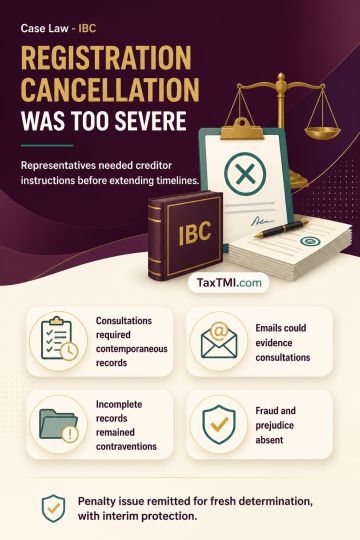
Disciplinary proportionality requires penalties for Authorised Representative misconduct to match proven harm, leading to reconsideration of registrat...
Political contribution deductions require genuine transactions; banking records and party registration alone cannot defeat evidence of accommodation e...
Post-death GST liability permits fresh proceedings against legal representatives, while discontinued-business recovery remains limited to the inherite...
Non-confirmation of FEMA seizure prevents adjudicators from overriding pending appellate findings on recorded reasons and suspected foreign asset hold...
The Appellate Tribunal affirmed the decision to exclude the Appellant and other unsecured Financial Creditors from the Committee of Creditors (CoC). The key issues were whether the Appellant qualified as a 'related party' and whether its claim as a financial creditor was valid. The Appellant's claim of Rs.195 crores was based on a Deed of Guarantee-cum-Indemnity executed by the Corporate Debtor. However, the Tribunal held that there can be 'financial debt' only when liability or obligation arises from a claim due from any person. Since the Appellant did not disburse the amount of Rs.195 crores to the principal borrower, its claim against the guarantor (Corporate Debtor) could not be admitted. The Tribunal emphasized the statutory requirement of financial statements evidencing the amounts drawn by the Corporate Debtor under a facility to prove the existence of debt. As the Adjudicating Authority had directed a transaction audit report, the parties were given liberty to file fresh applications based on the report's findings regarding the Appellant's status as a 'related party' or a Financial Creditor/secured creditor.
The Appellate Tribunal affirmed the decision to exclude the Appellant and other unsecured Financial Creditors from the Committee of Creditors (CoC). The key issues were whether the Appellant qualified as a 'related party' and whether its claim as a financial creditor was valid. The Appellant's claim of Rs.195 crores was based on a Deed of Guarantee-cum-Indemnity executed by the Corporate Debtor. However, the Tribunal held that there can be 'financial debt' only when liability or obligation arises from a claim due from any person. Since the Appellant did not disburse the amount of Rs.195 crores to the principal borrower, its claim against the guarantor (Corporate Debtor) could not be admitted. The Tribunal emphasized the statutory requirement of financial statements evidencing the amounts drawn by the Corporate Debtor under a facility to prove the existence of debt. As the Adjudicating Authority had directed a transaction audit report, the parties were given liberty to file fresh applications based on the report's findings regarding the Appellant's status as a 'related party' or a Financial Creditor/secured creditor.
Note: It is a system-generated summary and is for quick reference only.
 TaxTMI
  TaxTMI
 of 4918