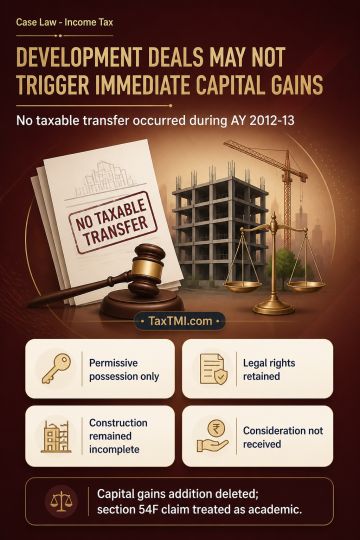
Development agreements require legal possession or effective enjoyment for capital gains transfer; permissive possession and deferred consideration de...
Prolonged sterilisation of development rights supports capital-gains treatment, while business-income disallowances cannot govern capital-gains comput...
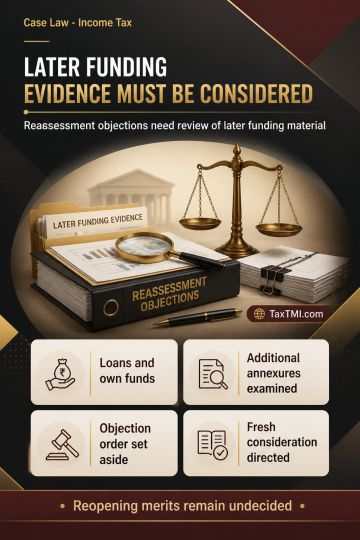
Additional evidence in transfer pricing dispute leads to fresh examination, while tax deductions, TDS credit, fee and refund interest require verifica...
Category II AIF pass-through taxation preserves non-business income character; investment receipts cannot be reclassified without applying recognised ...
The High Court examined whether it is appropriate to entertain a writ petition against a Provisional Attachment Order (PAO) issued under the Prevention of Money Laundering Act, 2002, before the statutory period of 30 days when the Adjudicating Authority is required to examine it. The Supreme Court has upheld the validity of Section 5 of the Act, finding adequate safeguards to give an opportunity to the aggrieved person to file objections before the Adjudicating Authority. The PAO is passed by the Director or authorized officer with reasons based on material in possession. Since sufficient remedies are available under the Act, the High Court held it inappropriate to entertain the petition before the 30-day period expires, except in rare and exceptional cases. The petitioner was relegated to avail alternative remedies, and the Adjudicating Authority was directed to expedite the matter without observations on merits.
The High Court examined whether it is appropriate to entertain a writ petition against a Provisional Attachment Order (PAO) issued under the Prevention of Money Laundering Act, 2002, before the statutory period of 30 days when the Adjudicating Authority is required to examine it. The Supreme Court has upheld the validity of Section 5 of the Act, finding adequate safeguards to give an opportunity to the aggrieved person to file objections before the Adjudicating Authority. The PAO is passed by the Director or authorized officer with reasons based on material in possession. Since sufficient remedies are available under the Act, the High Court held it inappropriate to entertain the petition before the 30-day period expires, except in rare and exceptional cases. The petitioner was relegated to avail alternative remedies, and the Adjudicating Authority was directed to expedite the matter without observations on merits.
Note: It is a system-generated summary and is for quick reference only.
 TaxTMI
  TaxTMI
 of 4807
















 Join Channel


