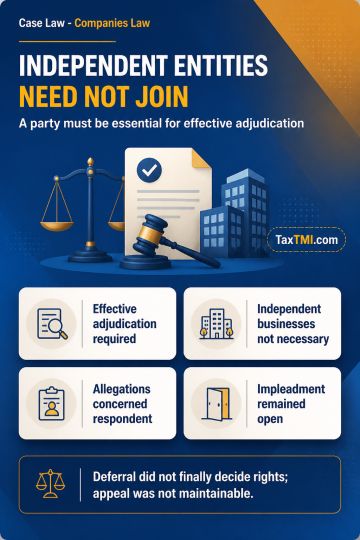
Necessary-party requirements limit impleadment of independent entities, while deferred consideration does not create an appealable adverse determinati...
Food supplement classification requires common parlance and authoritative tests, preventing treatment as proprietary Ayurvedic medicines without suppo...
Specified regulatory authority income receives conditional tax exemption, subject to non-commercial activity, unchanged income character, and return f...
Tax exemption for regulatory authority income applies retrospectively, subject to non-commercial activity, unchanged income sources, and return-filing...
Input tax credit conditions remain constitutionally valid, with eligible recipient claims considered under GST circulars and retrospective filing dead...
The summary focuses on the interpretation and applicability of Section 271D and Section 269SS of the Income Tax Act. The key points are: Section 271D imposes a penalty for violating the provisions of Section 269SS, which prohibits receiving a sum exceeding Rs. 20,000 as a loan or deposit from any person. However, Section 269SS does not cover the receipt of cash consideration for the sale of immovable property. The authorities erroneously interpreted Section 269SS and imposed a penalty u/s 271D for receiving cash consideration from the sale of immovable properties. The Appellate Tribunal held that the Assessing Officer committed an error in invoking Sections 269SS and 271D in this case and quashed the penalty imposed.
The summary focuses on the interpretation and applicability of Section 271D and Section 269SS of the Income Tax Act. The key points are: Section 271D imposes a penalty for violating the provisions of Section 269SS, which prohibits receiving a sum exceeding Rs. 20,000 as a loan or deposit from any person. However, Section 269SS does not cover the receipt of cash consideration for the sale of immovable property. The authorities erroneously interpreted Section 269SS and imposed a penalty u/s 271D for receiving cash consideration from the sale of immovable properties. The Appellate Tribunal held that the Assessing Officer committed an error in invoking Sections 269SS and 271D in this case and quashed the penalty imposed.
Note: It is a system-generated summary and is for quick reference only.
 TaxTMI
 of 4805




















 Join Channel


 TaxTMI