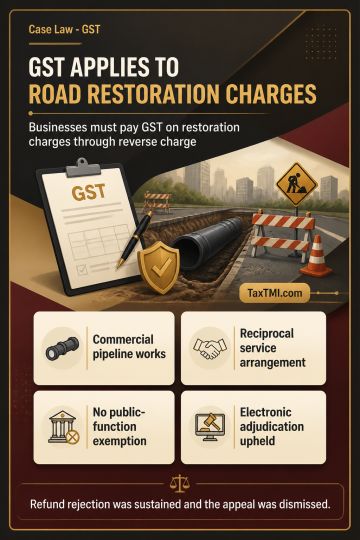
Request-driven road restoration attracts reverse-charge GST, not governmental-function treatment or compensatory-damages status for business recipient...
Road restoration charges for commercial pipeline works are taxable Government services, with reverse charge liability and no public-function exemption...
Model-wise import cap monitoring cannot justify withholding used multifunction machines where all-India tracking is absent and full security is furnis...
The assessee declared purchases from parties issuing bogus purchase vouchers without actual transactions, merely laundering unaccounted money to claim deduction u/s 80HHC. The Assessing Officer treated 25% of unverifiable purchases as income from other sources, alleging inflation of export profits. The CIT(A) confirmed this addition. The ITAT held that rejection of books u/s 145(3) requires specific conditions, which were not satisfied. The AO did not follow the proper procedure or point out defects in accounts. The ITAT relied on judicial precedents to conclude that no addition can be made if the declared gross profit rate is higher than the rate prescribed by the jurisdictional High Court in such cases. The assessee's gross profit rate was found reasonable based on comparable cases and the partner's statement recorded during the search. Consequently, the ITAT allowed the assessee's ground and deleted the addition of 25% of unverifiable purchases.
The assessee declared purchases from parties issuing bogus purchase vouchers without actual transactions, merely laundering unaccounted money to claim deduction u/s 80HHC. The Assessing Officer treated 25% of unverifiable purchases as income from other sources, alleging inflation of export profits. The CIT(A) confirmed this addition. The ITAT held that rejection of books u/s 145(3) requires specific conditions, which were not satisfied. The AO did not follow the proper procedure or point out defects in accounts. The ITAT relied on judicial precedents to conclude that no addition can be made if the declared gross profit rate is higher than the rate prescribed by the jurisdictional High Court in such cases. The assessee's gross profit rate was found reasonable based on comparable cases and the partner's statement recorded during the search. Consequently, the ITAT allowed the assessee's ground and deleted the addition of 25% of unverifiable purchases.
Note: It is a system-generated summary and is for quick reference only.
 TaxTMI
  TaxTMI
 of 4918