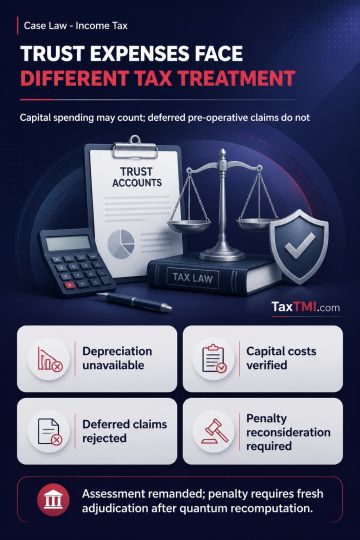
Charitable trust income application permits verified capital expenditure but rejects deferred pre-operative claims and requires reconsideration of con...
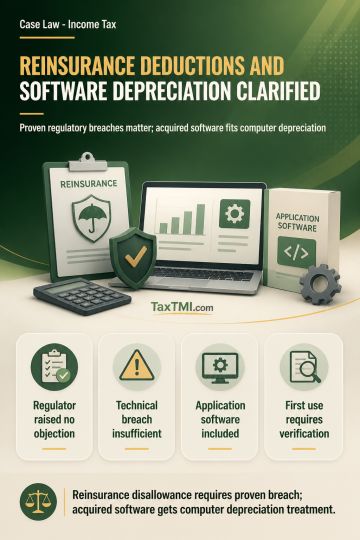
Reinsurance premium deductions require established regulatory breaches, while independently acquired software qualifies within the computer depreciati...
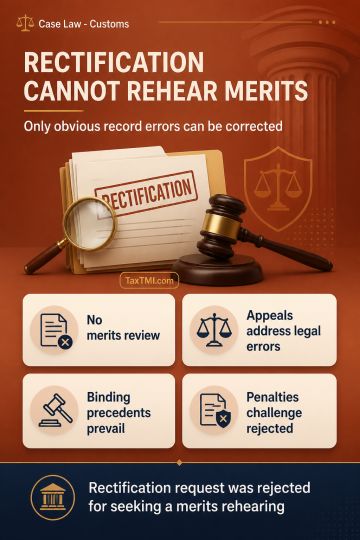
Rectification of mistake remains limited to self-evident record errors, preventing merits review through miscellaneous applications and preserving fin...
Tender creditworthiness conditions may extend to de facto Promoter Directors, with post-participation challenges generally barred absent arbitrariness...
Corporate representation in PMLA summons proceedings permitted through an authorised signatory, subject to directors' continuing cooperation and atten...
The crux pertains to levying penalty u/s 271(1)(c) for alleged furnishing of inaccurate particulars or concealment of income regarding capital gains computation on sale of land. The Tribunal held that adopting a different valuation for determining cost of acquisition based on estimation cannot be the basis for imposing penalty. The capital gains were computed by the assessee based on estimated cost as on 1.4.1981, which the Assessing Officer disagreed with and adopted the fair market value mentioned in the sale deed dated 17.11.1980 without referring to the District Valuation Officer. This recomputation based on material furnished by the assessee cannot attract penalty. Mere difference in estimation of cost by the authorities does not prove concealment or inaccurate particulars. The Assessing Officer failed to establish willful negligence, concealment or furnishing of inaccurate particulars. Penalty cannot be levied for estimated additions unless the factum of concealment or inaccurate particulars is proved. The Tribunal decided in favor of the assessee, holding penalty u/s 271(1)(c) as not imposable.
The crux pertains to levying penalty u/s 271(1)(c) for alleged furnishing of inaccurate particulars or concealment of income regarding capital gains computation on sale of land. The Tribunal held that adopting a different valuation for determining cost of acquisition based on estimation cannot be the basis for imposing penalty. The capital gains were computed by the assessee based on estimated cost as on 1.4.1981, which the Assessing Officer disagreed with and adopted the fair market value mentioned in the sale deed dated 17.11.1980 without referring to the District Valuation Officer. This recomputation based on material furnished by the assessee cannot attract penalty. Mere difference in estimation of cost by the authorities does not prove concealment or inaccurate particulars. The Assessing Officer failed to establish willful negligence, concealment or furnishing of inaccurate particulars. Penalty cannot be levied for estimated additions unless the factum of concealment or inaccurate particulars is proved. The Tribunal decided in favor of the assessee, holding penalty u/s 271(1)(c) as not imposable.
Note: It is a system-generated summary and is for quick reference only.
 TaxTMI
 of 4805













 Join Channel


 TaxTMI
