Statutory transfer formalities invalidated alleged share and property transfers, while retrospective record manipulation constituted oppression and mi...
Provisional attachment of laundered funds and equivalent-value property sustained, with statutory protection limited to pension, gratuity and providen...
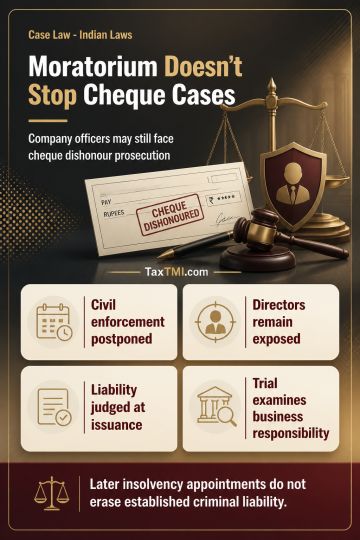
Insolvency moratorium does not shield company officers from cheque dishonour prosecution for liability arising before corporate insolvency proceedings...
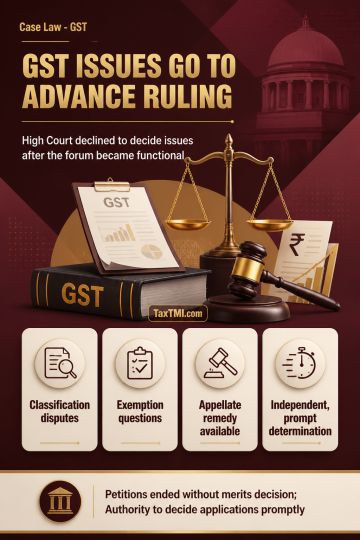
Advance-ruling mechanism governs pending GST classification, exemption and taxability disputes, limiting writ review once the specialised forum functi...
Page of 4805
Press 'Enter' after typing page number.
921 to 940 of 96092 Results
❮
❯
❯❯
0 / 200
Expand Note
Add to Folder
No Folders have been created
+
Are you sure you want to delete "My most important" ?
This is a summary of a case dealing with the determination of fair market value (FMV) for computing long-term capital gains (LTCG) and allowing deductions for cost of improvements. The key points are: the Tax Appellate Tribunal upheld the Assessing Officer's adoption of FMV as per the District Valuation Officer's report, rejecting the assessee's argument for using the 'reverse indexation method'. However, the Tribunal allowed the deduction for cost of improvement incurred in FY 1991-92, which was erroneously omitted by lower authorities. It also directed the Assessing Officer to rectify a mathematical mistake in computing the total indexed cost of improvement. The Tribunal's decision partially favored the assessee regarding the allowable deductions.
This is a summary of a case dealing with the determination of fair market value (FMV) for computing long-term capital gains (LTCG) and allowing deductions for cost of improvements. The key points are: the Tax Appellate Tribunal upheld the Assessing Officer's adoption of FMV as per the District Valuation Officer's report, rejecting the assessee's argument for using the 'reverse indexation method'. However, the Tribunal allowed the deduction for cost of improvement incurred in FY 1991-92, which was erroneously omitted by lower authorities. It also directed the Assessing Officer to rectify a mathematical mistake in computing the total indexed cost of improvement. The Tribunal's decision partially favored the assessee regarding the allowable deductions.
Note: It is a system-generated summary and is for quick reference only.
 TaxTMI
 of 4805













 Join Channel


 TaxTMI