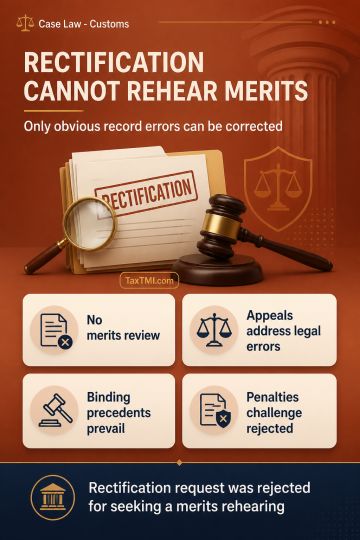
Rectification of mistake remains limited to self-evident record errors, preventing merits review through miscellaneous applications and preserving fin...
Tender creditworthiness conditions may extend to de facto Promoter Directors, with post-participation challenges generally barred absent arbitrariness...
Corporate representation in PMLA summons proceedings permitted through an authorised signatory, subject to directors' continuing cooperation and atten...
Helicopter charter classification requires effective control analysis, while territorial performance, reasoned credit orders and wilful suppression de...
Specified fund definition expands PAN exemption eligibility for registered alternative investment funds and qualifying International Financial Service...
Tax exemption for specified legal-services authority income applies retrospectively, subject to non-commercial activity, unchanged income sources, and...
Constitutional validity of Sections 104, 105, and 108 of the Customs Act, 1962, concerning the legality of search and seizure operations conducted by the respondents. It examines whether the alleged acts or omissions constitute prohibited goods or evasion of duty exceeding fifty lakh rupees, rendering Section 155 of the Criminal Procedure Code (Cr.P.C.) inapplicable. The court held that while gold is not absolutely prohibited, failure to comply with conditions amounts to prohibited goods u/ss 2(33) and 11 of the Act. The petitioners' alleged acts prima facie constitute prohibited goods, and the offence being cognizable with punishment up to 7 years, Section 155 of Cr.P.C. is inapplicable. Consequently, the court dismissed the stay applications, prima facie finding no grounds to grant a stay at this stage, subject to deciding the constitutional validity of the provisions in the main writ petitions.
Constitutional validity of Sections 104, 105, and 108 of the Customs Act, 1962, concerning the legality of search and seizure operations conducted by the respondents. It examines whether the alleged acts or omissions constitute prohibited goods or evasion of duty exceeding fifty lakh rupees, rendering Section 155 of the Criminal Procedure Code (Cr.P.C.) inapplicable. The court held that while gold is not absolutely prohibited, failure to comply with conditions amounts to prohibited goods u/ss 2(33) and 11 of the Act. The petitioners' alleged acts prima facie constitute prohibited goods, and the offence being cognizable with punishment up to 7 years, Section 155 of Cr.P.C. is inapplicable. Consequently, the court dismissed the stay applications, prima facie finding no grounds to grant a stay at this stage, subject to deciding the constitutional validity of the provisions in the main writ petitions.
Note: It is a system-generated summary and is for quick reference only.
 TaxTMI
 of 4805


















 Join Channel


 TaxTMI