Opportunity to respond to jurisdictional reports is mandatory before customs settlement duty enhancement; connected applications require consistent ad...
Specific customs headings for scaffolding components prevail over general classification, invalidating misclassification proceedings and enabling with...
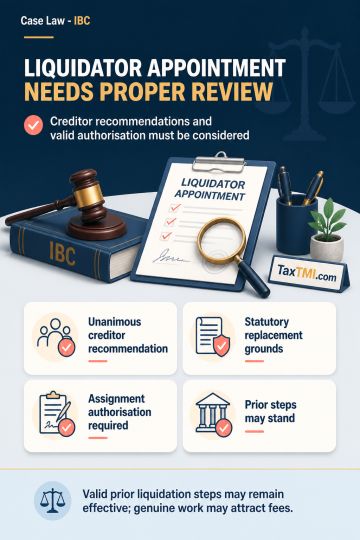
Liquidator appointment under Section 34 requires consideration of creditor recommendations, valid professional authorisation, and preservation of vali...
Income-tax exemption for specified regulatory fees and government grants applies subject to non-commercial activity and continuing compliance conditio...
Digital accessibility audit and remediation deadlines extended, while all other disability-compliance obligations for regulated entities remain unchan...
Page of 4803
Press 'Enter' after typing page number.
621 to 640 of 96047 Results
❮
❯
❯❯
0 / 200
Expand Note
Add to Folder
No Folders have been created
+
Are you sure you want to delete "My most important" ?
Constitutional validity of Sections 104, 105, and 108 of the Customs Act, 1962, concerning the legality of search and seizure operations conducted by the respondents. It examines whether the alleged acts or omissions constitute prohibited goods or evasion of duty exceeding fifty lakh rupees, rendering Section 155 of the Criminal Procedure Code (Cr.P.C.) inapplicable. The court held that while gold is not absolutely prohibited, failure to comply with conditions amounts to prohibited goods u/ss 2(33) and 11 of the Act. The petitioners' alleged acts prima facie constitute prohibited goods, and the offence being cognizable with punishment up to 7 years, Section 155 of Cr.P.C. is inapplicable. Consequently, the court dismissed the stay applications, prima facie finding no grounds to grant a stay at this stage, subject to deciding the constitutional validity of the provisions in the main writ petitions.
Constitutional validity of Sections 104, 105, and 108 of the Customs Act, 1962, concerning the legality of search and seizure operations conducted by the respondents. It examines whether the alleged acts or omissions constitute prohibited goods or evasion of duty exceeding fifty lakh rupees, rendering Section 155 of the Criminal Procedure Code (Cr.P.C.) inapplicable. The court held that while gold is not absolutely prohibited, failure to comply with conditions amounts to prohibited goods u/ss 2(33) and 11 of the Act. The petitioners' alleged acts prima facie constitute prohibited goods, and the offence being cognizable with punishment up to 7 years, Section 155 of Cr.P.C. is inapplicable. Consequently, the court dismissed the stay applications, prima facie finding no grounds to grant a stay at this stage, subject to deciding the constitutional validity of the provisions in the main writ petitions.
Note: It is a system-generated summary and is for quick reference only.
 TaxTMI
 of 4803




















 Join Channel


 TaxTMI