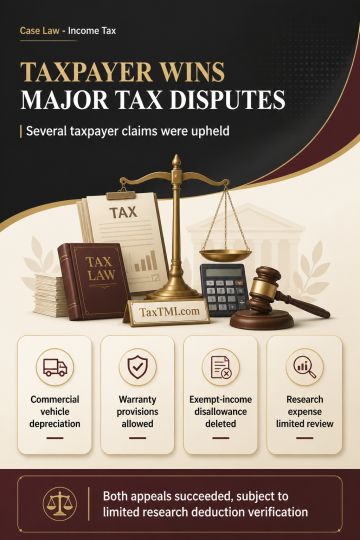
Commercial vehicle depreciation, scientifically determined warranty provisions and exempt-income disallowances were resolved in favour of the taxpayer...
Inherited property sale proceeds require capital-gains treatment where ownership is supported by evidence, not suspicion or unverified signature doubt...
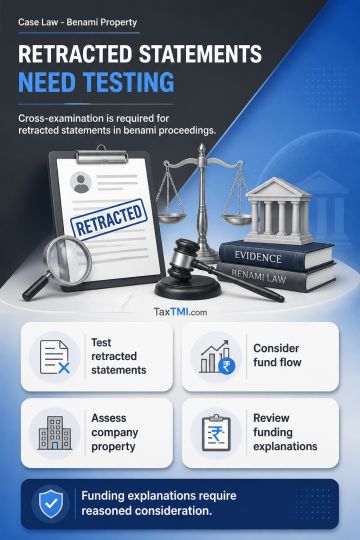
Cross-examination of retracted statements is essential where foundational evidence supports a benami allegation and documented funding explanations re...
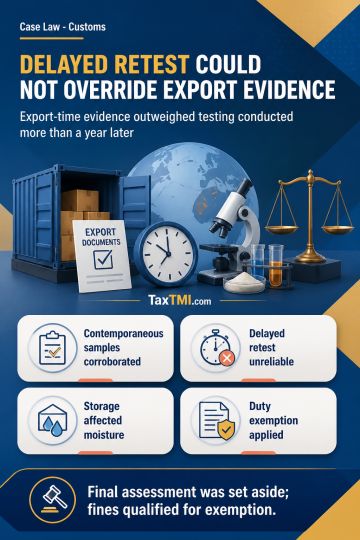
Capital-goods exemption covers plant-modernisation accessories, while the import restriction applies only to earlier capital-goods components and spar...
Constitutional validity of Sections 104, 105, and 108 of the Customs Act, 1962, concerning the legality of search and seizure operations conducted by the respondents. It examines whether the alleged acts or omissions constitute prohibited goods or evasion of duty exceeding fifty lakh rupees, rendering Section 155 of the Criminal Procedure Code (Cr.P.C.) inapplicable. The court held that while gold is not absolutely prohibited, failure to comply with conditions amounts to prohibited goods u/ss 2(33) and 11 of the Act. The petitioners' alleged acts prima facie constitute prohibited goods, and the offence being cognizable with punishment up to 7 years, Section 155 of Cr.P.C. is inapplicable. Consequently, the court dismissed the stay applications, prima facie finding no grounds to grant a stay at this stage, subject to deciding the constitutional validity of the provisions in the main writ petitions.
Constitutional validity of Sections 104, 105, and 108 of the Customs Act, 1962, concerning the legality of search and seizure operations conducted by the respondents. It examines whether the alleged acts or omissions constitute prohibited goods or evasion of duty exceeding fifty lakh rupees, rendering Section 155 of the Criminal Procedure Code (Cr.P.C.) inapplicable. The court held that while gold is not absolutely prohibited, failure to comply with conditions amounts to prohibited goods u/ss 2(33) and 11 of the Act. The petitioners' alleged acts prima facie constitute prohibited goods, and the offence being cognizable with punishment up to 7 years, Section 155 of Cr.P.C. is inapplicable. Consequently, the court dismissed the stay applications, prima facie finding no grounds to grant a stay at this stage, subject to deciding the constitutional validity of the provisions in the main writ petitions.
Note: It is a system-generated summary and is for quick reference only.
 TaxTMI
 of 4801



















 Join Channel


 TaxTMI