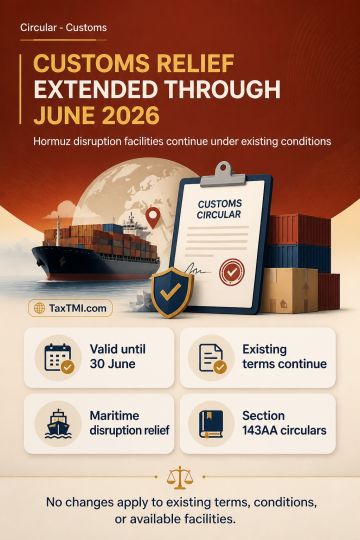
Customs relief for Strait of Hormuz maritime disruptions remains available, with existing conditions continuing unchanged through the extended validit...
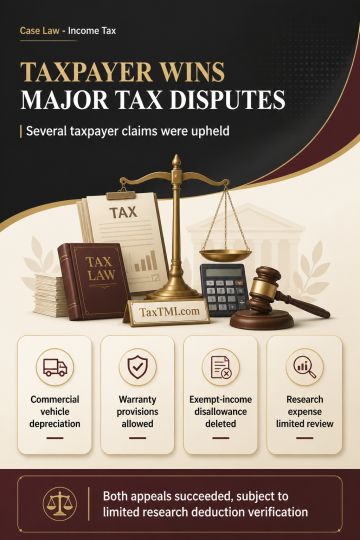
Commercial vehicle depreciation, scientifically determined warranty provisions and exempt-income disallowances were resolved in favour of the taxpayer...
Page of 4786
Press 'Enter' after typing page number.
121 to 140 of 95715 Results
❮
❯
❯❯
0 / 200
Expand Note
Add to Folder
No Folders have been created
+
Are you sure you want to delete "My most important" ?
Benefit of exemption under S. No. 512 of Notification No. 50/2017-Customs for parts/components imported for manufacturing Lithium Ion Batteries. The department denied the exemption on the grounds that the appellant manufactured power banks instead of Lithium Ion Batteries. The Tribunal held that the appellant utilized all imported parts/components to manufacture its product, complying with the notification's conditions. The controversy centered on whether the manufactured product was a Lithium Ion Battery or a power bank. The Tribunal stated that the exemption benefit should not be extended to circumvent or stretch beyond its intended scope. The term "manufacture" in the notification must be interpreted considering the IGCR Rules, 2017. The Tribunal noted that lithium-ion cells were initially covered under S. No. 512 but were later moved to a separate entry with a 5% duty rate, indicating that the subject goods were initially exempted. The Tribunal concluded that the power bank is essentially a Lithium Ion Battery connected to a printed circuit board for voltage conversion, and the appellant rightly claimed the exemption by utilizing the imported raw materials to manufacture Lithium Ion Batteries, which were then used to make power banks. Regarding the extended period of limitation, the Tribunal held that since the appellant complied with the notification's conditions, the demand for duty not paid from January to June.
Benefit of exemption under S. No. 512 of Notification No. 50/2017-Customs for parts/components imported for manufacturing Lithium Ion Batteries. The department denied the exemption on the grounds that the appellant manufactured power banks instead of Lithium Ion Batteries. The Tribunal held that the appellant utilized all imported parts/components to manufacture its product, complying with the notification's conditions. The controversy centered on whether the manufactured product was a Lithium Ion Battery or a power bank. The Tribunal stated that the exemption benefit should not be extended to circumvent or stretch beyond its intended scope. The term "manufacture" in the notification must be interpreted considering the IGCR Rules, 2017. The Tribunal noted that lithium-ion cells were initially covered under S. No. 512 but were later moved to a separate entry with a 5% duty rate, indicating that the subject goods were initially exempted. The Tribunal concluded that the power bank is essentially a Lithium Ion Battery connected to a printed circuit board for voltage conversion, and the appellant rightly claimed the exemption by utilizing the imported raw materials to manufacture Lithium Ion Batteries, which were then used to make power banks. Regarding the extended period of limitation, the Tribunal held that since the appellant complied with the notification's conditions, the demand for duty not paid from January to June.
Note: It is a system-generated summary and is for quick reference only.
 TaxTMI
 of 4786




 Join Channel


 TaxTMI