Inherited property sale proceeds require capital-gains treatment where ownership is supported by evidence, not suspicion or unverified signature doubt...
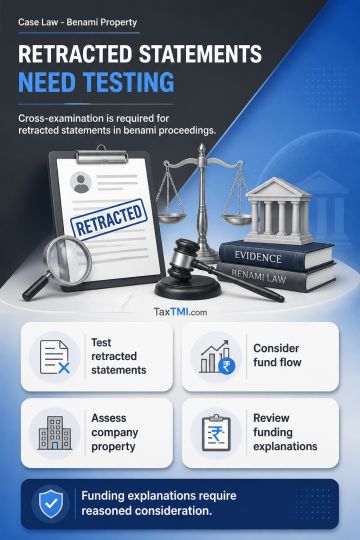
Cross-examination of retracted statements is essential where foundational evidence supports a benami allegation and documented funding explanations re...
Capital-goods exemption covers plant-modernisation accessories, while the import restriction applies only to earlier capital-goods components and spar...
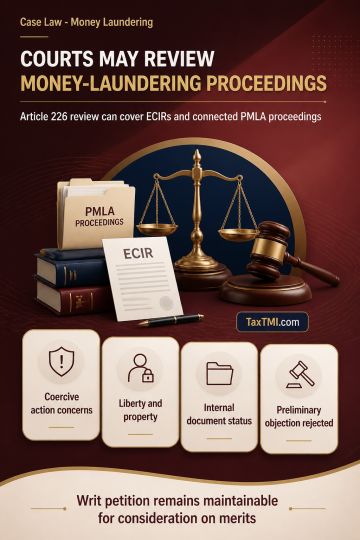
Constitutional judicial review permits challenges to ECIRs and connected money-laundering proceedings where coercive action affects fundamental intere...
The court dealt with the power to cancel GST registration retrospectively u/s 29 of the Central Goods and Services Tax Act, 2017. It held that while the provision enables retrospective cancellation, the mere existence of such power does not justify its invocation. The order u/s 29(2) must reflect reasons for cancelling registration retrospectively, considering the deleterious consequences. The power cannot be exercised robotically or routinely unless circumstances warrant. The impugned order lacked reasoning for retroactive cancellation, violating the statutory scheme. Relying on Ramesh Chander's case, the court emphasized that retrospective cancellation should consider denying input tax credit to customers, and such consequences must be intended and warranted. Failing to provide even rudimentary reasons, the impugned order was quashed, and the petition was allowed.
The court dealt with the power to cancel GST registration retrospectively u/s 29 of the Central Goods and Services Tax Act, 2017. It held that while the provision enables retrospective cancellation, the mere existence of such power does not justify its invocation. The order u/s 29(2) must reflect reasons for cancelling registration retrospectively, considering the deleterious consequences. The power cannot be exercised robotically or routinely unless circumstances warrant. The impugned order lacked reasoning for retroactive cancellation, violating the statutory scheme. Relying on Ramesh Chander's case, the court emphasized that retrospective cancellation should consider denying input tax credit to customers, and such consequences must be intended and warranted. Failing to provide even rudimentary reasons, the impugned order was quashed, and the petition was allowed.
Note: It is a system-generated summary and is for quick reference only.
 TaxTMI
 of 4780













 Join Channel


 TaxTMI