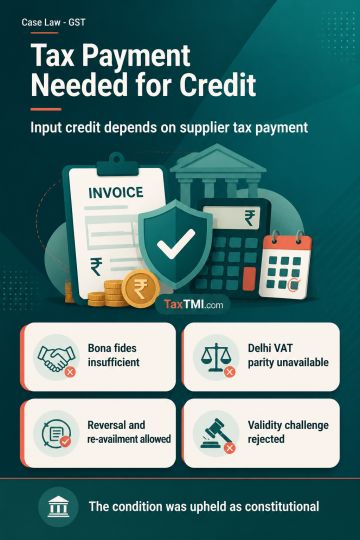
Input tax credit conditions remain constitutionally valid, with eligible recipient claims considered under GST circulars and retrospective filing dead...
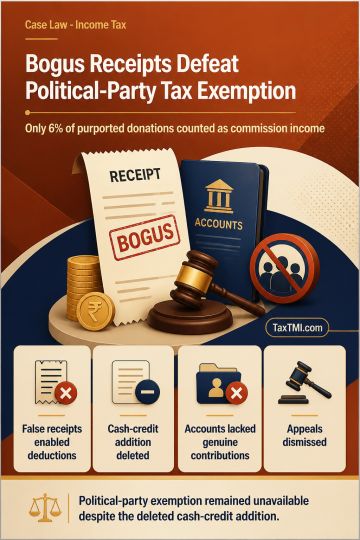
Bogus donation receipts justified commission income assessment and defeated political-party tax exemption for inaccurate accounts and reporting failur...
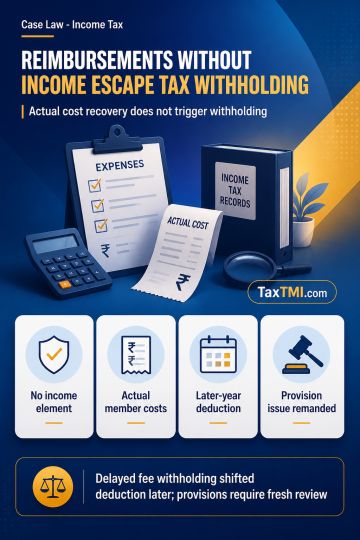
Pure reimbursement without income element escapes tax withholding, while delayed withholding and unsupported provisions face deferred or renewed scrut...
Public benefit requirement defeats charitable registration where residents' association services are reciprocal, member-only facilities governed by mu...
Exempt-income expenditure disallowance is confined to investments that actually generated exempt income, while supported business expenses remain dedu...
The court dealt with the power to cancel GST registration retrospectively u/s 29 of the Central Goods and Services Tax Act, 2017. It held that while the provision enables retrospective cancellation, the mere existence of such power does not justify its invocation. The order u/s 29(2) must reflect reasons for cancelling registration retrospectively, considering the deleterious consequences. The power cannot be exercised robotically or routinely unless circumstances warrant. The impugned order lacked reasoning for retroactive cancellation, violating the statutory scheme. Relying on Ramesh Chander's case, the court emphasized that retrospective cancellation should consider denying input tax credit to customers, and such consequences must be intended and warranted. Failing to provide even rudimentary reasons, the impugned order was quashed, and the petition was allowed.
The court dealt with the power to cancel GST registration retrospectively u/s 29 of the Central Goods and Services Tax Act, 2017. It held that while the provision enables retrospective cancellation, the mere existence of such power does not justify its invocation. The order u/s 29(2) must reflect reasons for cancelling registration retrospectively, considering the deleterious consequences. The power cannot be exercised robotically or routinely unless circumstances warrant. The impugned order lacked reasoning for retroactive cancellation, violating the statutory scheme. Relying on Ramesh Chander's case, the court emphasized that retrospective cancellation should consider denying input tax credit to customers, and such consequences must be intended and warranted. Failing to provide even rudimentary reasons, the impugned order was quashed, and the petition was allowed.
Note: It is a system-generated summary and is for quick reference only.
 TaxTMI
 of 4782








 Join Channel


 TaxTMI