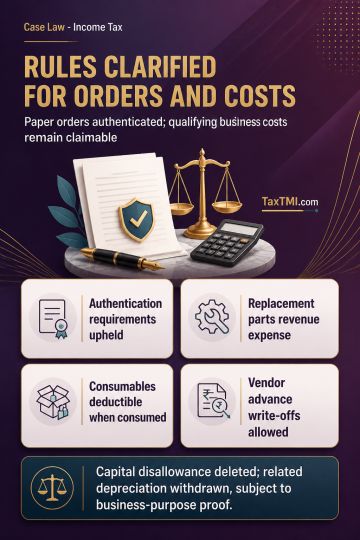
Authentication of paper assessment orders upheld, while qualifying repairs, consumables and vendor advance write-offs remain deductible business claim...
Transaction value cannot be rejected solely on non-statutory valuation guidelines without corroborative evidence supporting reassessment of final cust...
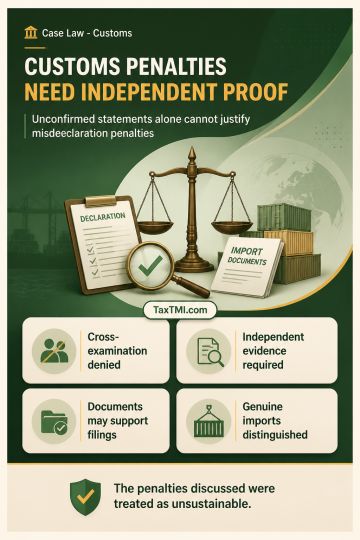
Cross-examination rights and corroborated evidence limit customs penalties for misdeclaration in genuine import transactions involving documented clea...
Page of 4782
Press 'Enter' after typing page number.
301 to 320 of 95636 Results
❮
❯
❯❯
0 / 200
Expand Note
Add to Folder
No Folders have been created
+
Are you sure you want to delete "My most important" ?
The court dealt with the power to cancel GST registration retrospectively u/s 29 of the Central Goods and Services Tax Act, 2017. It held that while the provision enables retrospective cancellation, the mere existence of such power does not justify its invocation. The order u/s 29(2) must reflect reasons for cancelling registration retrospectively, considering the deleterious consequences. The power cannot be exercised robotically or routinely unless circumstances warrant. The impugned order lacked reasoning for retroactive cancellation, violating the statutory scheme. Relying on Ramesh Chander's case, the court emphasized that retrospective cancellation should consider denying input tax credit to customers, and such consequences must be intended and warranted. Failing to provide even rudimentary reasons, the impugned order was quashed, and the petition was allowed.
The court dealt with the power to cancel GST registration retrospectively u/s 29 of the Central Goods and Services Tax Act, 2017. It held that while the provision enables retrospective cancellation, the mere existence of such power does not justify its invocation. The order u/s 29(2) must reflect reasons for cancelling registration retrospectively, considering the deleterious consequences. The power cannot be exercised robotically or routinely unless circumstances warrant. The impugned order lacked reasoning for retroactive cancellation, violating the statutory scheme. Relying on Ramesh Chander's case, the court emphasized that retrospective cancellation should consider denying input tax credit to customers, and such consequences must be intended and warranted. Failing to provide even rudimentary reasons, the impugned order was quashed, and the petition was allowed.
Note: It is a system-generated summary and is for quick reference only.
 TaxTMI
 of 4782












 Join Channel


 TaxTMI