Just a moment...

Top
Help
×

By creating an account you can:

Logo TaxTMI
>
Call Us / Help / Feedback

Contact Us At :

E-mail: [email protected]

Call / WhatsApp at: +91 99117 96707

For more information, Check Contact Us

FAQs :

To know Frequently Asked Questions, Check FAQs

Most Asked Video Tutorials :

For more tutorials, Check Video Tutorials

Submit Feedback/Suggestion :

Email :
Please provide your email address so we can follow up on your feedback.
Category :
Description :
Min 15 characters0/2000
Add to...
You have not created any category. Kindly create one to bookmark this item!
Create New Category
Hide
Title :
Description :
❮❮ Hide
Default View
Expand ❯❯
Close ✕
🔎 Highlights - Adv. Search
TEXT SEARCH:

Press 'Enter' to add multiple search terms. Rules for Better Search

Search In:
Main Text + AI Text
  • Main Text
  • Main Text + AI Text
  • AI Text
Law:
---- All Laws----
  • ---- All Laws----
  • Income Tax
  • Direct Taxes
  • Benami Property
  • Central GST Laws
  • SGST - State GST Laws
  • Customs
  • FTP - Foreign Trade Policy
  • SEZ - Special Economic Zone
  • FEMA - Foreign Exchange Management
  • Companies Law
  • SEBI - Securities & Exchange Board of India
  • IBC - Insolvency and Bankruptcy
  • Law of Competition
  • PMLA - Money-Laundering
  • Indian Laws
  • Bill / Finance Bills
  • Wealth Tax
  • Service Tax
  • Central Excise
  • VAT / Sales Tax
Month:
---- All Months ----
  • ---- All Months ----
  • January
  • February
  • March
  • April
  • May
  • June
  • July
  • August
  • September
  • October
  • November
  • December
Year:
---- All Years ----
  • ---- All Years ----
  • 2026
  • 2025
  • 2024
  • 2023
  • 2022
  • 2021
  • 2020
  • 2019
  • 2018
  • 2017
  • 2016
  • 2015
  • 2014
  • 2013
  • 2012
  • 2011
Sort By: ?
In Sort By 'Default', exact matches for text search are shown at the top, followed by the remaining results in their regular order.
RelevanceDefaultDate
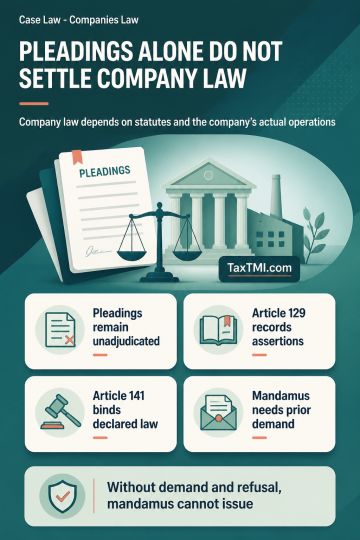
    Unadjudicated Supreme Court pleadings do not determine company law applicability, and mandamus requires prior demand and refusal.
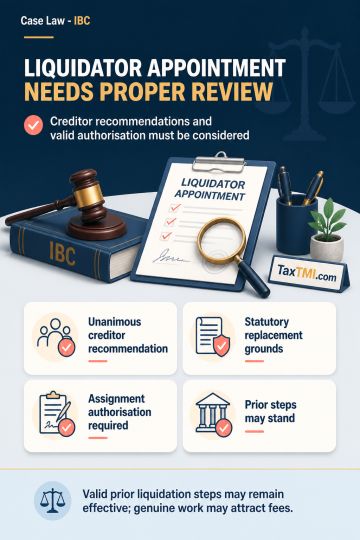
    Liquidator appointment under Section 34 requires consideration of creditor recommendations, valid professional authorisation, and preservation of vali...
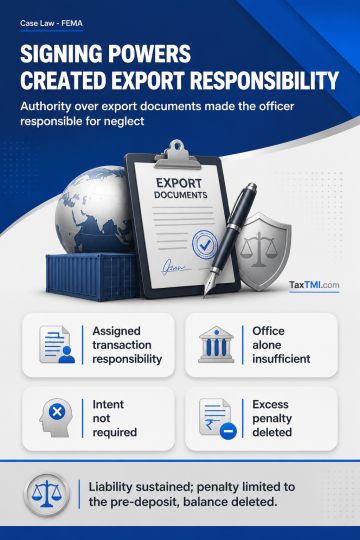
    Vicarious liability for export proceeds arose from assigned transaction responsibility, while FEMA civil penalty required no mens rea.
    Medical bail request dismissed as the High Court application remained pending, with assurances of necessary treatment in custody.
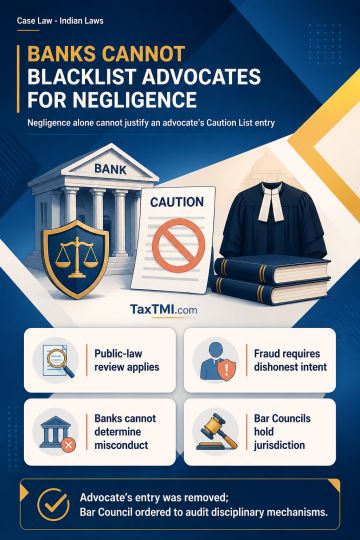
    Public-law scrutiny of banking fraud caution lists bars blacklisting advocates for alleged negligence without fraud or disciplinary process.
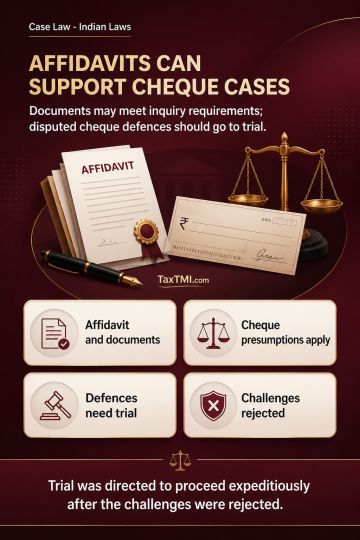
    Mandatory pre-summoning inquiry may be met by affidavit and documents; cheque-liability presumptions require disputed defences to face trial.
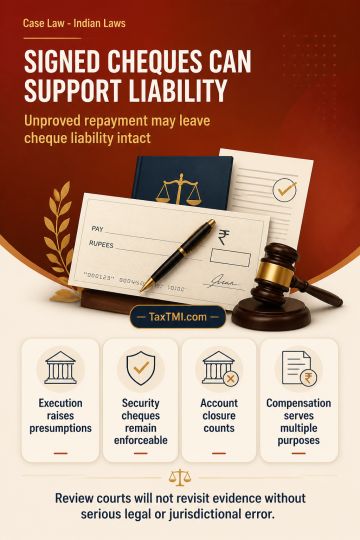
    Cheque execution presumptions sustain liability where repayment remains unproved, including for security cheques and account-closed dishonour.
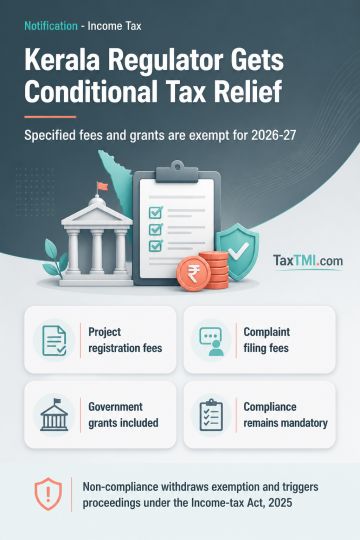
    Income-tax exemption for specified regulatory fees and government grants applies subject to non-commercial activity and continuing compliance conditio...
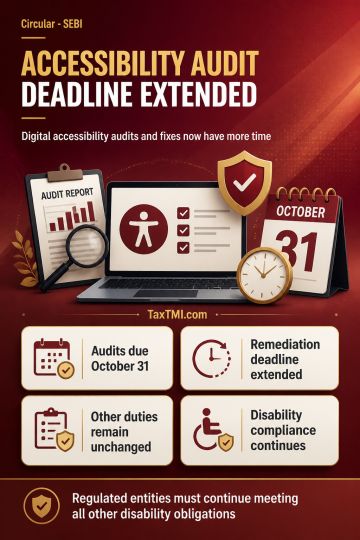
    Digital accessibility audit and remediation deadlines extended, while all other disability-compliance obligations for regulated entities remain unchan...
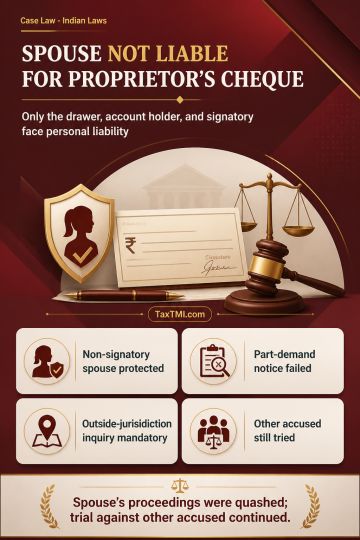
    Cheque-dishonour liability remains personal: non-signatory spouse cannot be vicariously prosecuted for a sole proprietorship's dishonoured cheque.
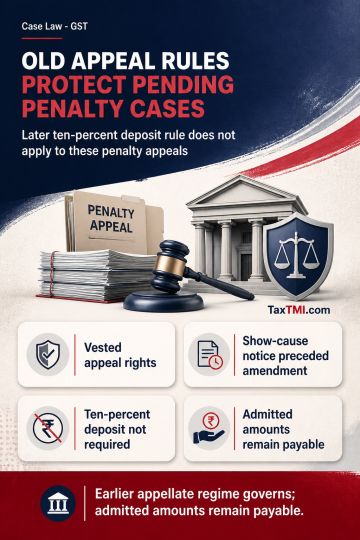
    Vested appellate rights protect pending penalty proceedings from later pre-deposit conditions unless legislation clearly requires retrospective applic...
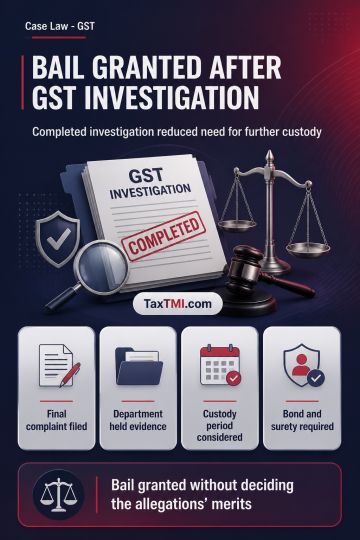
    Regular bail in alleged input tax credit fraud granted after investigation concluded and evidence remained in departmental custody.
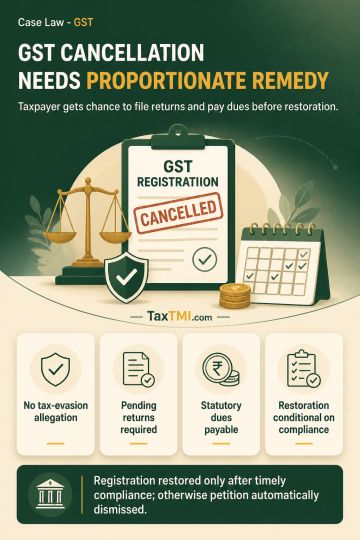
    Proportionality in GST registration cancellation requires an opportunity to file pending returns and pay statutory dues before restoration.
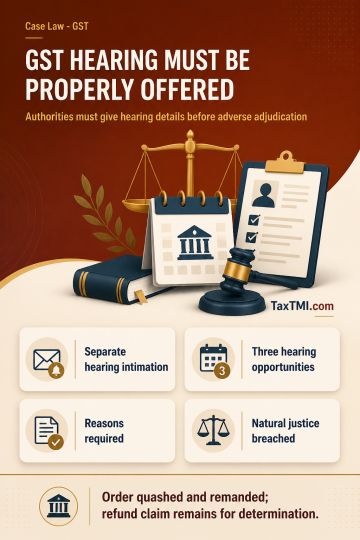
    Personal hearing in GST adjudication remains mandatory; inadequate notice and an unreasoned adverse order require fresh determination.
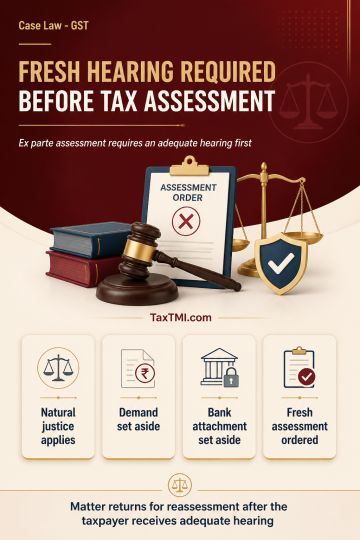
    Adequate hearing before ex parte tax assessment requires fresh assessment after consequential demand and bank-account attachment are set aside.
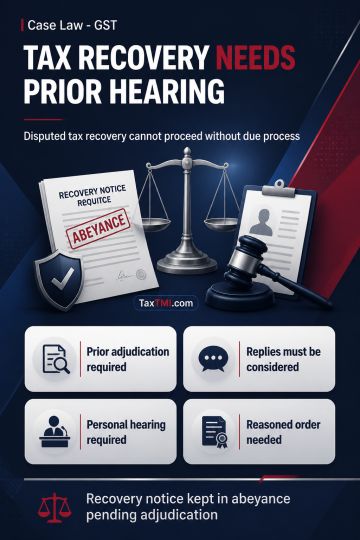
    Garnishee recovery requires prior adjudication, consideration of taxpayer replies, and a personal hearing before coercive recovery proceeds.
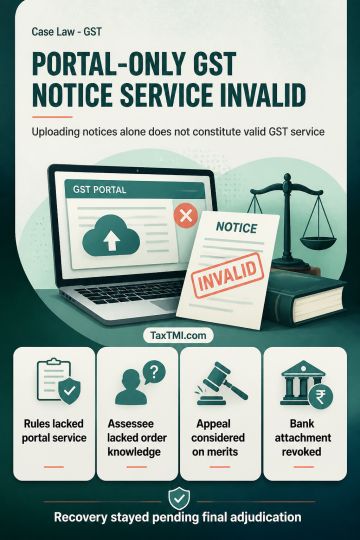
    GST portal-only service of notices and orders is invalid when rules do not prescribe it as a service mode.
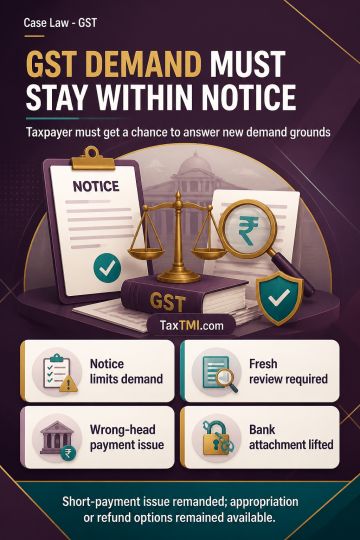
    Show cause notice limits GST demand grounds; wrong-head IGST payment may be appropriated against CGST and SGST liabilities.
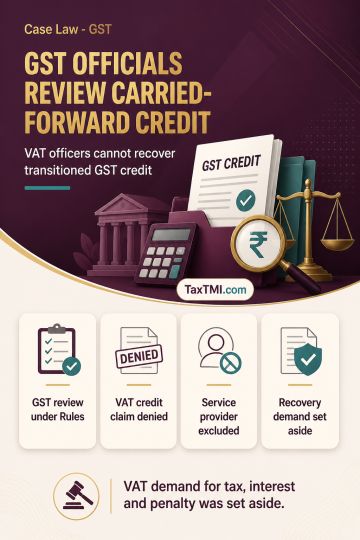
    Transitional GST credit must be examined by GST authorities, while VAT authorities cannot recover tax, interest or penalties.
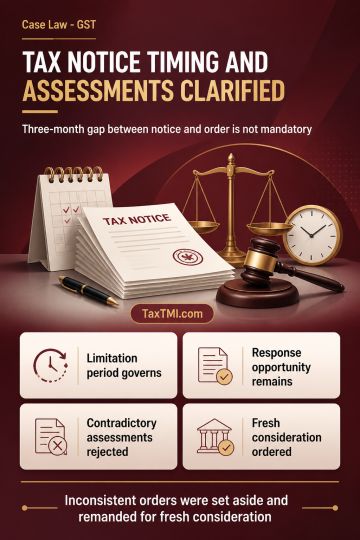
    Section 73 notice timing does not require a three-month notice-to-order gap; inconsistent tax assessments require fresh consideration.
❯❯
MaximizeMaximizeMaximize
0 / 200
Expand Note
Add to Folder

No Folders have been created

    +

    Are you sure you want to delete "My most important" ?

    NOTE:

    Highlights
    Showing Results for :
    Reset Filters
    Results Found:
    Show All SummariesHide All Summaries

    Highlights

    Back

    All Highlights

    Showing Results for :
    Reset Filters
      No Records Found

      Highlights

      Back

      All Highlights

      whatsappJoin Channel
      Showing Results for : Reset Filters

      The applicant purchases second-hand gold or diamond jewelry from...

      Transforming Second-Hand Jewelry into New Pieces Qualifies as Manufacturing, Affects GST Margin Rule Application.

      Contents
      Summary
      Note

      Note

      -

      Bookmark

      Print

      Print

      GSTOctober 5, 2024Case LawsAAR
      The applicant purchases second-hand gold or diamond jewelry from unregistered individuals, melts and transforms them into new pieces, altering their nature and characteristics. This process constitutes manufacturing u/s 2(72) of the GST Act, where the purchased gold is used as a raw material or input to make a new commodity. When the applicant melts the jewelry into gold lumps, the nature of the goods changes, and the characteristics and classification are altered. In such cases, the applicant cannot avail the benefit of Rule 32(5) of the CGST Rules, 2017, which allows paying GST on the margin value (difference between selling and purchase price) for second-hand goods. The applicant cannot adopt the valuation method prescribed in Rule 32(5) when the old jewelry is melted to manufacture a new ornament. However, if the old gold ornaments are purchased and supplied after minor processing that does not change their nature, the applicant can pay tax on the value determined u/r 32(5). Rule 32(5) is available only when a registered person deals solely in buying and selling second-hand goods. If engaged in other activities like manufacturing or selling new articles, the applicant cannot avail the benefit of Rule 32(5) and must pay GST at the applicable rate on the actual value of the commodity, not the margin value.

      Topics

      ActsIncome Tax