Prolonged sterilisation of development rights supports capital-gains treatment, while business-income disallowances cannot govern capital-gains comput...
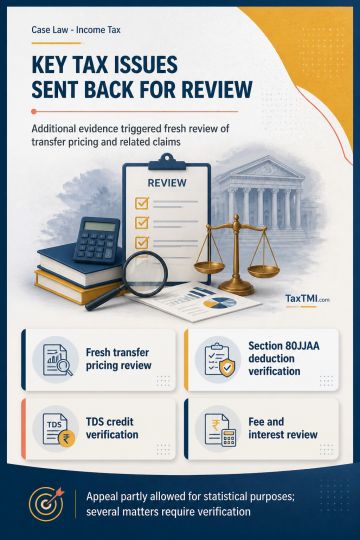
Additional evidence in transfer pricing dispute leads to fresh examination, while tax deductions, TDS credit, fee and refund interest require verifica...
Category II AIF pass-through taxation preserves non-business income character; investment receipts cannot be reclassified without applying recognised ...
Mutual fund maturity rules require proper rollover, redemption, disclosure, and due diligence; investor gains cannot excuse regulatory breaches or pen...
Threshold exemption excludes exempt services, while stamp-paper purchases avoid reverse charge; consequential service tax penalties were also set asid...
This judgment deals with the validity of reassessment notices issued u/s 148 of the Income Tax Act between July and September 2022, in light of the Tax Ordinance and the Supreme Court's decision in Ashish Agarwal. The key points are: The Court clarified that directions issued under Article 142 are not binding ratios but supplementary measures to achieve complete justice. It exercised this power in tax matters where Revenue actions were not per law. The Court deemed reassessment notices issued under the old regime between April 1 and June 30, 2021, as show-cause notices under the new regime in Ashish Agarwal, balancing assessee and Revenue rights and avoiding further appeals. The legal fiction created a deemed stay on proceedings till the Revenue supplied relevant information to assessees per the Court's directions. Exclusions apply for computing limitation u/s 149. After April 1, 2021, the Income Tax Act must be read with substituted provisions and the Tax Ordinance applies if actions fall between March 20, 2020, and March 31, 2021. Section 3(1) overrides Section 149 only for relaxing reassessment notice time limits. Reassessment notices under the new regime must be issued within the surviving time limit under the Act read with the Ordinance; notices beyond this.
This judgment deals with the validity of reassessment notices issued u/s 148 of the Income Tax Act between July and September 2022, in light of the Tax Ordinance and the Supreme Court's decision in Ashish Agarwal. The key points are: The Court clarified that directions issued under Article 142 are not binding ratios but supplementary measures to achieve complete justice. It exercised this power in tax matters where Revenue actions were not per law. The Court deemed reassessment notices issued under the old regime between April 1 and June 30, 2021, as show-cause notices under the new regime in Ashish Agarwal, balancing assessee and Revenue rights and avoiding further appeals. The legal fiction created a deemed stay on proceedings till the Revenue supplied relevant information to assessees per the Court's directions. Exclusions apply for computing limitation u/s 149. After April 1, 2021, the Income Tax Act must be read with substituted provisions and the Tax Ordinance applies if actions fall between March 20, 2020, and March 31, 2021. Section 3(1) overrides Section 149 only for relaxing reassessment notice time limits. Reassessment notices under the new regime must be issued within the surviving time limit under the Act read with the Ordinance; notices beyond this.
Note: It is a system-generated summary and is for quick reference only.
 TaxTMI
 of 4792














 Join Channel


 TaxTMI
