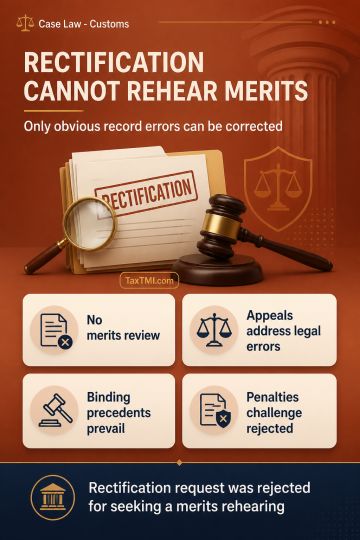
Rectification of mistake remains limited to self-evident record errors, preventing merits review through miscellaneous applications and preserving fin...
Tender creditworthiness conditions may extend to de facto Promoter Directors, with post-participation challenges generally barred absent arbitrariness...
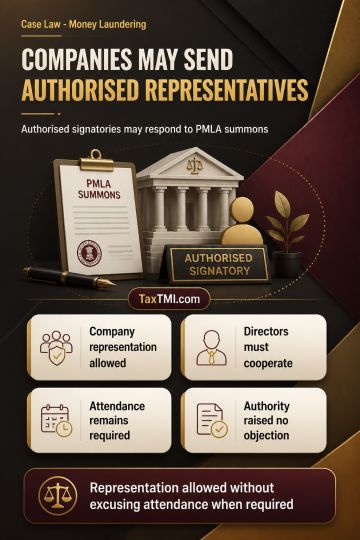
Corporate representation in PMLA summons proceedings permitted through an authorised signatory, subject to directors' continuing cooperation and atten...
Helicopter charter classification requires effective control analysis, while territorial performance, reasoned credit orders and wilful suppression de...
Specified fund definition expands PAN exemption eligibility for registered alternative investment funds and qualifying International Financial Service...
Page of 4786
Press 'Enter' after typing page number.
581 to 600 of 95715 Results
❮
❯
❯❯
0 / 200
Expand Note
Add to Folder
No Folders have been created
+
Are you sure you want to delete "My most important" ?
This judgment deals with the validity of reassessment notices issued u/s 148 of the Income Tax Act between July and September 2022, in light of the Tax Ordinance and the Supreme Court's decision in Ashish Agarwal. The key points are: The Court clarified that directions issued under Article 142 are not binding ratios but supplementary measures to achieve complete justice. It exercised this power in tax matters where Revenue actions were not per law. The Court deemed reassessment notices issued under the old regime between April 1 and June 30, 2021, as show-cause notices under the new regime in Ashish Agarwal, balancing assessee and Revenue rights and avoiding further appeals. The legal fiction created a deemed stay on proceedings till the Revenue supplied relevant information to assessees per the Court's directions. Exclusions apply for computing limitation u/s 149. After April 1, 2021, the Income Tax Act must be read with substituted provisions and the Tax Ordinance applies if actions fall between March 20, 2020, and March 31, 2021. Section 3(1) overrides Section 149 only for relaxing reassessment notice time limits. Reassessment notices under the new regime must be issued within the surviving time limit under the Act read with the Ordinance; notices beyond this.
This judgment deals with the validity of reassessment notices issued u/s 148 of the Income Tax Act between July and September 2022, in light of the Tax Ordinance and the Supreme Court's decision in Ashish Agarwal. The key points are: The Court clarified that directions issued under Article 142 are not binding ratios but supplementary measures to achieve complete justice. It exercised this power in tax matters where Revenue actions were not per law. The Court deemed reassessment notices issued under the old regime between April 1 and June 30, 2021, as show-cause notices under the new regime in Ashish Agarwal, balancing assessee and Revenue rights and avoiding further appeals. The legal fiction created a deemed stay on proceedings till the Revenue supplied relevant information to assessees per the Court's directions. Exclusions apply for computing limitation u/s 149. After April 1, 2021, the Income Tax Act must be read with substituted provisions and the Tax Ordinance applies if actions fall between March 20, 2020, and March 31, 2021. Section 3(1) overrides Section 149 only for relaxing reassessment notice time limits. Reassessment notices under the new regime must be issued within the surviving time limit under the Act read with the Ordinance; notices beyond this.
Note: It is a system-generated summary and is for quick reference only.
 TaxTMI
 of 4786














 Join Channel


 TaxTMI