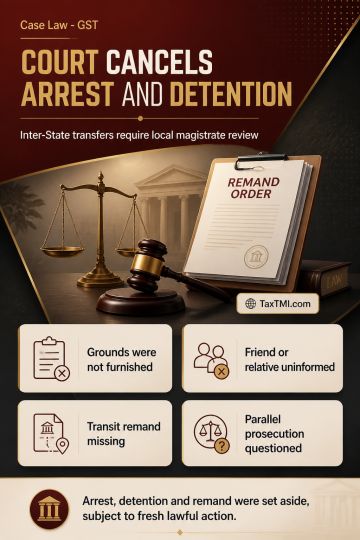
Arrest safeguards and transit remand requirements invalidated detention following inter-State transfer without communicated grounds or magistrate auth...
Arrest safeguards require disclosed grounds, relative intimation and transit remand, while duplicate prosecution under the CGST framework is unsustain...
Document Identification Number defects can invalidate GST assessments, with delayed challenges entertained conditionally where patent irregularities e...
Windmill commissioning evidence supported higher depreciation where grid connection and electricity generation proved operational use before the relev...
Pharmaceutical promotion and transfer-pricing comparability principles limited disallowances, while uncorroborated search allegations and unsupported ...
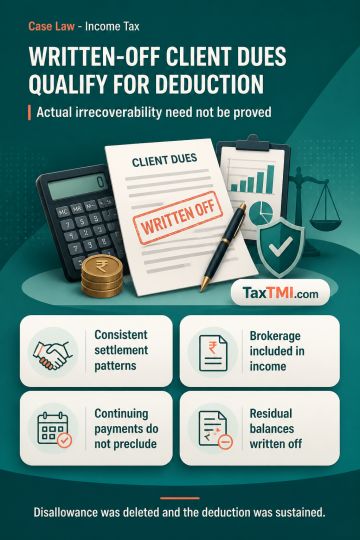
Business expenditure substantiation supports scrap credits, statutory payments and expense claims, while depreciation requires proof of actual busines...
This judgment deals with the validity of reassessment notices issued u/s 148 of the Income Tax Act between July and September 2022, in light of the Tax Ordinance and the Supreme Court's decision in Ashish Agarwal. The key points are: The Court clarified that directions issued under Article 142 are not binding ratios but supplementary measures to achieve complete justice. It exercised this power in tax matters where Revenue actions were not per law. The Court deemed reassessment notices issued under the old regime between April 1 and June 30, 2021, as show-cause notices under the new regime in Ashish Agarwal, balancing assessee and Revenue rights and avoiding further appeals. The legal fiction created a deemed stay on proceedings till the Revenue supplied relevant information to assessees per the Court's directions. Exclusions apply for computing limitation u/s 149. After April 1, 2021, the Income Tax Act must be read with substituted provisions and the Tax Ordinance applies if actions fall between March 20, 2020, and March 31, 2021. Section 3(1) overrides Section 149 only for relaxing reassessment notice time limits. Reassessment notices under the new regime must be issued within the surviving time limit under the Act read with the Ordinance; notices beyond this.
This judgment deals with the validity of reassessment notices issued u/s 148 of the Income Tax Act between July and September 2022, in light of the Tax Ordinance and the Supreme Court's decision in Ashish Agarwal. The key points are: The Court clarified that directions issued under Article 142 are not binding ratios but supplementary measures to achieve complete justice. It exercised this power in tax matters where Revenue actions were not per law. The Court deemed reassessment notices issued under the old regime between April 1 and June 30, 2021, as show-cause notices under the new regime in Ashish Agarwal, balancing assessee and Revenue rights and avoiding further appeals. The legal fiction created a deemed stay on proceedings till the Revenue supplied relevant information to assessees per the Court's directions. Exclusions apply for computing limitation u/s 149. After April 1, 2021, the Income Tax Act must be read with substituted provisions and the Tax Ordinance applies if actions fall between March 20, 2020, and March 31, 2021. Section 3(1) overrides Section 149 only for relaxing reassessment notice time limits. Reassessment notices under the new regime must be issued within the surviving time limit under the Act read with the Ordinance; notices beyond this.
Note: It is a system-generated summary and is for quick reference only.
 TaxTMI
 of 4784



















 Join Channel


 TaxTMI