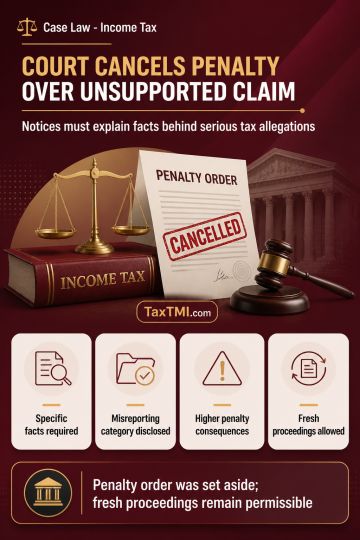
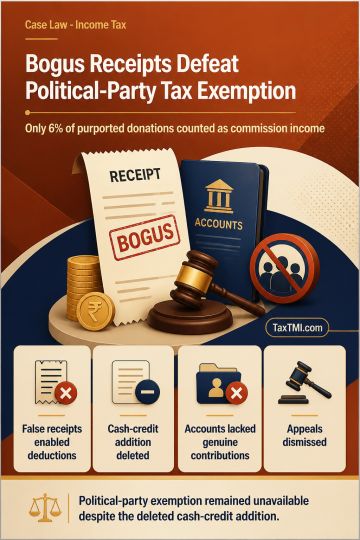
Bogus donation receipts justified commission income assessment and defeated political-party tax exemption for inaccurate accounts and reporting failur...
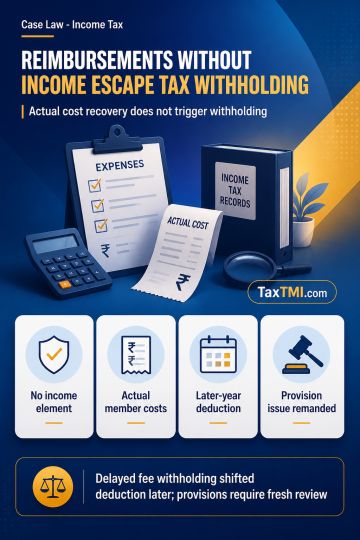
Pure reimbursement without income element escapes tax withholding, while delayed withholding and unsupported provisions face deferred or renewed scrut...
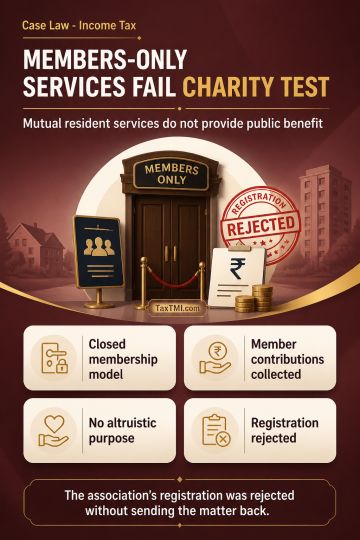
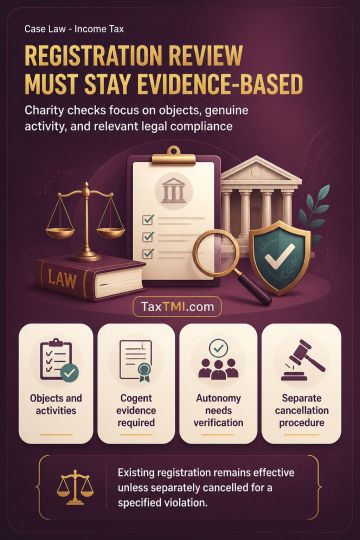
Public benefit requirement defeats charitable registration where residents' association services are reciprocal, member-only facilities governed by mu...
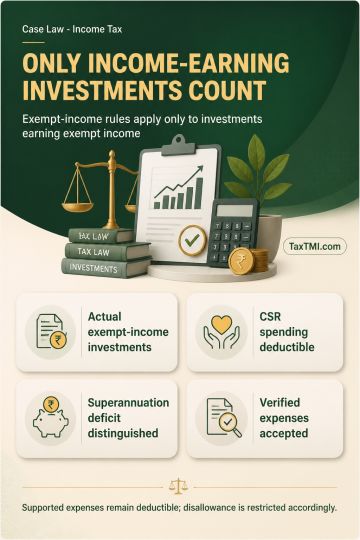
Exempt-income expenditure disallowance is confined to investments that actually generated exempt income, while supported business expenses remain dedu...
The case pertains to the taxability of compensation received by the assessee for termination of a contract. The key points are: The assessee received Rs. 4,30,88,084 as compensation for terminating a bottling contract with Hindustan Coca-Cola Beverages Pvt Ltd due to trade disputes. The Revenue contended that the amount was taxable u/ss 28(iv)/28(va) or 45, arguing it did not represent termination compensation exempt under Oberoi Hotels case. However, the Tribunal, after examining the settlement agreement and financial statements, upheld the CIT(A)'s finding that the source of income had ceased, making it a non-taxable capital receipt under Oberoi Hotels. Regarding disallowance of 20% of raw material purchases, the ITAT restricted it to 10%, observing that while the assessee must justify claims, the AO cannot make ad-hoc disallowances without scientific basis if documents are unavailable. The High Court upheld the ITAT's view.
The case pertains to the taxability of compensation received by the assessee for termination of a contract. The key points are: The assessee received Rs. 4,30,88,084 as compensation for terminating a bottling contract with Hindustan Coca-Cola Beverages Pvt Ltd due to trade disputes. The Revenue contended that the amount was taxable u/ss 28(iv)/28(va) or 45, arguing it did not represent termination compensation exempt under Oberoi Hotels case. However, the Tribunal, after examining the settlement agreement and financial statements, upheld the CIT(A)'s finding that the source of income had ceased, making it a non-taxable capital receipt under Oberoi Hotels. Regarding disallowance of 20% of raw material purchases, the ITAT restricted it to 10%, observing that while the assessee must justify claims, the AO cannot make ad-hoc disallowances without scientific basis if documents are unavailable. The High Court upheld the ITAT's view.
Note: It is a system-generated summary and is for quick reference only.
 TaxTMI
 of 4790



 Join Channel


 TaxTMI
