Tax deduction compliance and payee income recognition govern consultancy disallowance, while no exempt income prevents related expenditure disallowanc...
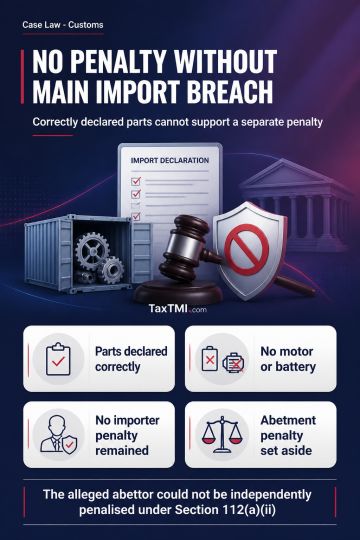
Derivative abetment liability fails when correctly declared imported components establish no underlying improper importation by the principal importer...
Interpretation of the term "otherwise" in Section 269SS of the Income Tax Act and the applicability of the penalty u/s 271D for accepting cash consideration on the sale of immovable property. The Tribunal applied the doctrine of "Ejusdem Generis" and held that the word "otherwise" should be interpreted narrowly and cannot include "sale consideration." The Tribunal found reasonable cause u/s 273B for the assessee's failure to comply with Section 269SS, considering the lack of intention to generate unaccounted money, disclosure of the cash receipt in the return, and the assessee's lack of knowledge about the legal provisions. The penalty u/s 271D was deleted in favor of the assessee.
Interpretation of the term "otherwise" in Section 269SS of the Income Tax Act and the applicability of the penalty u/s 271D for accepting cash consideration on the sale of immovable property. The Tribunal applied the doctrine of "Ejusdem Generis" and held that the word "otherwise" should be interpreted narrowly and cannot include "sale consideration." The Tribunal found reasonable cause u/s 273B for the assessee's failure to comply with Section 269SS, considering the lack of intention to generate unaccounted money, disclosure of the cash receipt in the return, and the assessee's lack of knowledge about the legal provisions. The penalty u/s 271D was deleted in favor of the assessee.
Note: It is a system-generated summary and is for quick reference only.
 TaxTMI
 of 4792














 Join Channel


 TaxTMI
