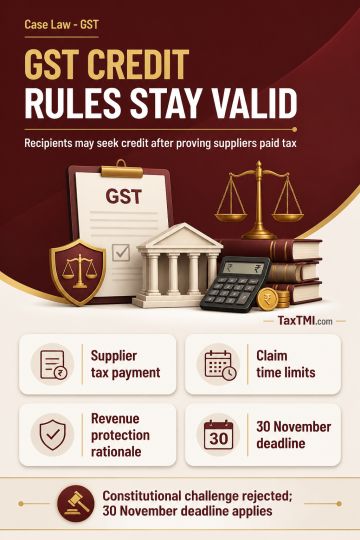
Input tax credit conditions remain constitutionally valid, with eligible recipient claims considered under GST circulars and retrospective filing dead...
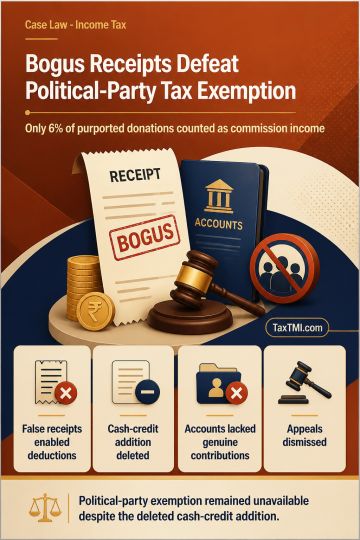
Bogus donation receipts justified commission income assessment and defeated political-party tax exemption for inaccurate accounts and reporting failur...
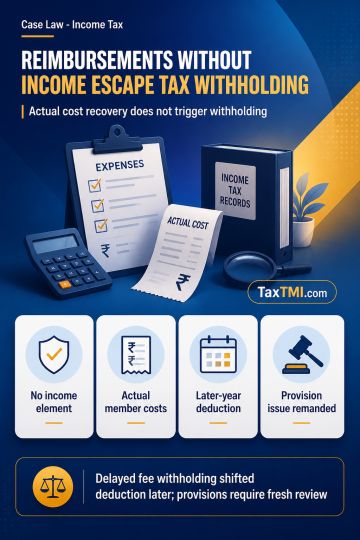
Pure reimbursement without income element escapes tax withholding, while delayed withholding and unsupported provisions face deferred or renewed scrut...
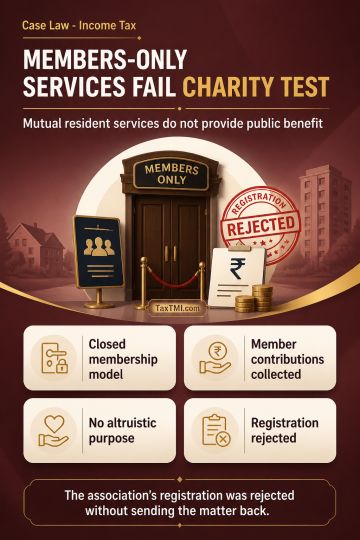
Public benefit requirement defeats charitable registration where residents' association services are reciprocal, member-only facilities governed by mu...
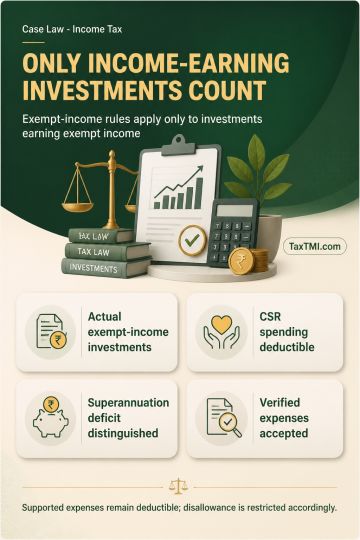
Exempt-income expenditure disallowance is confined to investments that actually generated exempt income, while supported business expenses remain dedu...
Page of 4796
Press 'Enter' after typing page number.
621 to 640 of 95918 Results
❮
❯
❯❯
0 / 200
Expand Note
Add to Folder
No Folders have been created
+
Are you sure you want to delete "My most important" ?
Disallowance of deduction u/s 80IB(10) and the levy of penalty u/s 271(1)(c). The Assessing Officer disallowed the deduction claim on two grounds: most residential units exceeded 1500 square feet, and the assessee was a contractor, not a developer. The Tribunal held that mentioning 1500 sq ft in the sanction plan is not determinative of the actual area constructed, and if the extra area does not breach building bylaws, it is irrelevant for civil authorities. The assessee failed to prove the units were under 1500 sq ft and that it was a developer executing sale deeds for loan purposes. The Tribunal distinguished the cited cases as involving debatable additions, whereas here, the claim was based on incorrect facts of the assessee being a developer and units exceeding 1500 sq ft. Hence, the penalty u/s 271(1)(c) was rightly confirmed.
Disallowance of deduction u/s 80IB(10) and the levy of penalty u/s 271(1)(c). The Assessing Officer disallowed the deduction claim on two grounds: most residential units exceeded 1500 square feet, and the assessee was a contractor, not a developer. The Tribunal held that mentioning 1500 sq ft in the sanction plan is not determinative of the actual area constructed, and if the extra area does not breach building bylaws, it is irrelevant for civil authorities. The assessee failed to prove the units were under 1500 sq ft and that it was a developer executing sale deeds for loan purposes. The Tribunal distinguished the cited cases as involving debatable additions, whereas here, the claim was based on incorrect facts of the assessee being a developer and units exceeding 1500 sq ft. Hence, the penalty u/s 271(1)(c) was rightly confirmed.
Note: It is a system-generated summary and is for quick reference only.
 TaxTMI
 of 4796





 Join Channel


 TaxTMI