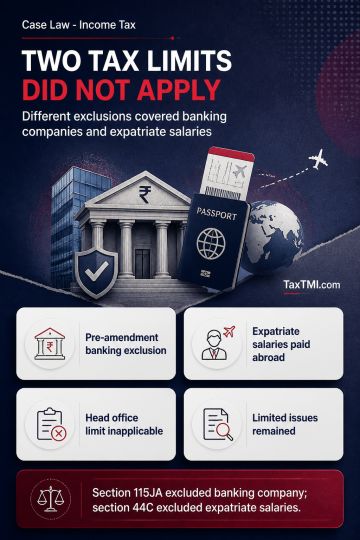
Minimum alternate tax exclusions for pre-amendment banking companies and expatriate Indian branch salaries remain outside head office expenditure limi...
Page of 4800
Press 'Enter' after typing page number.
1101 to 1120 of 96000 Results
❮
❯
❯❯
0 / 200
Expand Note
Add to Folder
No Folders have been created
+
Are you sure you want to delete "My most important" ?
The assessment order passed u/s 144C(3) was beyond the prescribed period of one month from the end of the month in which the period for filing objections u/s 144C(2) expired. Although the assessee filed objections before the Dispute Resolution Panel beyond the 30-day period, the Assessing Officer was still required to pass the final order within the stipulated timeframe u/s 144C(4). The High Court upheld the Tribunal's decision to set aside the final assessment order as being time-barred, rejecting the Revenue's argument that the assessee cannot take advantage of its own delay in filing objections. The statutory language of Section 144C(4) is unambiguous, and the Assessing Officer's failure to comply with the time limit renders the order invalid, irrespective of the assessee's delay.
The assessment order passed u/s 144C(3) was beyond the prescribed period of one month from the end of the month in which the period for filing objections u/s 144C(2) expired. Although the assessee filed objections before the Dispute Resolution Panel beyond the 30-day period, the Assessing Officer was still required to pass the final order within the stipulated timeframe u/s 144C(4). The High Court upheld the Tribunal's decision to set aside the final assessment order as being time-barred, rejecting the Revenue's argument that the assessee cannot take advantage of its own delay in filing objections. The statutory language of Section 144C(4) is unambiguous, and the Assessing Officer's failure to comply with the time limit renders the order invalid, irrespective of the assessee's delay.
Note: It is a system-generated summary and is for quick reference only.
 TaxTMI
 of 4800






 Join Channel


 TaxTMI